Introduction
Activins are dimeric growth and differentiation factors which belong to the transforming growth factor-beta (TGF-beta) superfamily of structurally related signaling proteins. Activins signal through a heteromeric complex of receptor serine kinases which include at least two type I ( I and IB) and two type II (II and IIB) receptors. These receptors are all transmembrane proteins, composed of a ligand-binding extracellular domain with cysteine-rich region, a transmembrane domain, and a cytoplasmic domain with predicted serine/threonine specificity. Type I receptors are essential for signaling; and type II receptors are required for binding ligands and for expression of type I receptors. Type I and II receptors form a stable complex after ligand binding, resulting in phosphorylation of type I receptors by type II receptors. This gene encodes activin A type I receptor which signals a particular transcriptional response in concert with activin type II receptors. Mutations in this gene are associated with fibrodysplasia ossificans progressive.
Specificity
Predicted Reactivity
Mouse, Rat, Bovine
Other Names
ACVR1; ACVRLK2; Activin receptor type-1; Activin receptor type I; Activin receptor-like kinase 2; Serine/threonine-protein kinase receptor R1; TGF-B superfamily receptor type I
NCBI Accession #
NP_001096.1;NP_001104537.1
Other Accession #
P80201; P37172; Q28041; NP_001104537.1; NP_001096.1
Format
Type
Peptide Affinity Purified Rabbit Polyclonal Antibody (Pab)
Calculated Molecular Weight (Da)
57153
Recommended Dilutions
WB: 1:1000
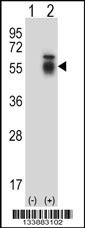 | Western blot analysis of ACVR1 (arrow) using rabbit polyclonal ACVR1 Antibody (Center) (Cat# 102-12194). 293 cell lysates (2 ug/lane) either nontransfected (Lane 1) or transiently transfected (Lane 2) with the ACVR1 gene. |
Antigen Source
HUMAN
Storage/Stability
2-8°C (short-term); -20°C (long-term)
Expiration:
12 months from the date of shipment when stored properly.