Drug Antibody (DA) and Anti-Drug Antibody (ADA) Assays
Therapeutic biologics can elicit immune responses that result in the formation of antibodies directed against the drug, potentially impacting safety, efficacy, and pharmacokinetics. RayBiotech’s Drug Antibody (DA) and Anti-Drug Antibody (ADA) assays use a bridging immunoassay format to quantify therapeutic antibodies and host-generated anti-drug antibodies, supporting immunogenicity assessment and drug exposure evaluation across biologic development programs.
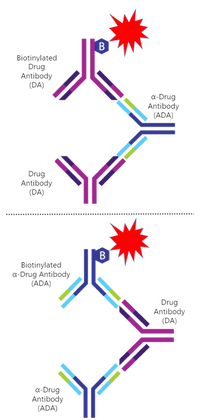
RayBiotech’s ADA and DA assays are based on the antibody bridge model, a specialized sandwich immunoassay approach designed for analytes with two or more identical binding sites, such as antibodies. In this format, drug molecules, drug antibodies, or anti-drug antibodies form a “bridge” between capture and detection reagents, enabling sensitive and specific detection of drug-directed immune responses.
These assays are available in both cytometric bead-based and plate-based bridging ELISA formats. In a typical workflow, samples are incubated with immobilized drug antibodies to capture ADA, or immobilized anti-drug antibodies to capture DA, present in serum or plasma. A biotinylated form of the corresponding antibody is then added, followed by streptavidin conjugate–mediated detection, producing a signal proportional to the amount of antibody bound. Quantification is achieved by comparison to a standard curve generated from ADA or DA standards at known concentrations.
All RayBiotech ADA and DA assays are developed and manufactured in the United States to support reliable immunogenicity and drug exposure assessment across discovery, preclinical, and translational research.


![[55637, 'Anti-Etanercept ELISA kit', ''] Standard Curve](https://cdn11.bigcommerce.com/s-xbhidqlvdb/images/stencil/80x80/products/55637/98228/ead-anetaner_curve__86707.1791373343.jpg?compression=lossy)

![[55635, 'Anti-Certolizumab ELISA kit', ''] Standard Curve](https://cdn11.bigcommerce.com/s-xbhidqlvdb/images/stencil/80x80/products/55635/99018/ead-ancerto_curve__11909.1792751422.jpg?compression=lossy)