RayBiotech

3607 Parkway Ln Ste 200 Norcross, Georgia 30092

www.RayBiotech.com | info@raybiotech.com

770-729-2992 | +1-888-494-8555

ISO 13485:2016 cGMP

Anti-BRG1 Antibody

Catalog #: 102-26586

Mouse Anti-BRG1 Antibody, 100 µl

Product Description

Specifications

Size100 µL
Estimated Lead Time1-2 weeks
SpeciesHuman, Mouse
Host SpeciesMouse
Accession Number
P51532
Gene Id
6597
Gene Symbols
SMARCA4
Protein Name / Synonyms
ATP dependent helicase SMARCA4;ATP-dependent helicase SMARCA4;BAF 190;BAF190;BAF190A;Brahma protein homolog 1;Brahma protein like 1;BRG1;BRG1 associated factor 190A;BRG1 protein;BRG1-associated factor 190A;BRM/SWI2 related gene 1;Global transcription activator homologous sequence;global transcription activator snf2l4;Homeotic gene regulator;hSNF2b;Mitotic growth and transcription activator;MRD16;Nuclear protein GRB1;Protein brahma homolog 1;Protein BRG
ClonalityMonoclonal
Recommended ApplicationsWestern Blotting, ICC, IP
Research AreaCancer
Shipping TypeBlue ice
Storage-20°C

Description

Introduction

Transcriptional coactivator cooperating with nuclear hormone receptors to potentiate transcriptional activation. Component of the CREST-BRG1 complex, a multiprotein complex that regulates promoter activation by orchestrating a calcium-dependent release of a repressor complex and a recruitment of an activator complex. In resting neurons, transcription of the c-FOS promoter is inhibited by BRG1-dependent recruitment of a phospho-RB1-HDAC repressor complex. Upon calcium influx, RB1 is dephosphorylated by calcineurin, which leads to release of the repressor complex. At the same time, there is increased recruitment of CREBBP to the promoter by a CREST-dependent mechanism, which leads to transcriptional activation. The CREST-BRG1 complex also binds to the NR2B promoter, and activity-dependent induction of NR2B expression involves a release of HDAC1 and recruitment of CREBBP. Belongs to the neural progenitors-specific chromatin remodeling complex (npBAF complex) and the neuron-specific chromatin remodeling complex (nBAF complex). During neural development a switch from a stem/progenitor to a post-mitotic chromatin remodeling mechanism occurs as neurons exit the cell cycle and become committed to their adult state. The transition from proliferating neural stem/progenitor cells to post-mitotic neurons requires a switch in subunit composition of the npBAF and nBAF complexes. As neural progenitors exit mitosis and differentiate into neurons, npBAF complexes which contain ACTL6A/BAF53A and PHF10/BAF45A, are exchanged for homologous alternative ACTL6B/BAF53B and DPF1/BAF45B or DPF3/BAF45C subunits in neuron- specific complexes (nBAF). The npBAF complex is essential for the self-renewal/proliferative capacity of the multipotent neural stem cells. The nBAF complex along with CREST plays a role regulating the activity of genes essential for dendrite growth. SMARCA4/BAF190A may promote neural stem cell self- renewal/proliferation by enhancing Notch-dependent proliferative signals, while concurrently making the neural stem cell insensitive to SHH-dependent differentiating cues (By similarity). Also involved in vitamin D-coupled transcription regulation via its association with the WINAC complex, a chromatin-remodeling complex recruited by vitamin D receptor (VDR), which is required for the ligand-bound VDR-mediated transrepression of the CYP27B1 gene. Acts as a corepressor of ZEB1 to regulate E-cadherin transcription and is required for induction of epithelial- mesenchymal transition (EMT) by ZEB1.

Other Information

Antigen Type
Recombinant Protein

Images

WB (1:1000)

Western blot detection of BRG1 in Hela NE,F9 and K562 cell lysates using BRG1 mouse mAb (1:1000 diluted).Predicted band size:220KDa.Observed band size:220KDa.
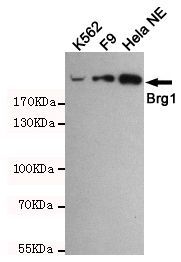
WB
ICC (1:50)

Immunofluorescent analysis of Hela cells fixed with 4% Paraformaldehyde and using anti-BRG1 mouse mAb (dilution 1:50). DAPI was used to stain nucleus(blue).
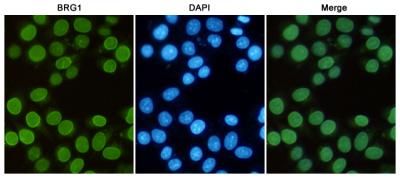
ICC
IP (1:500)

Immunoprecipitation analysis of K562 cell lysates using BRG1 mouse mAb (201025).
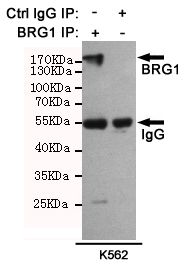
IP

Storage/Stability

2-8°C (short-term); -20°C (long-term)
Expiration:
12 months from the date of shipment when stored properly.