RayBiotech

3607 Parkway Ln Ste 200 Norcross, Georgia 30092

www.RayBiotech.com | info@raybiotech.com

770-729-2992 | +1-888-494-8555

ISO 13485:2016 cGMP

Anti-CRYBA1 (Center) Antibody

Catalog #: 102-11533

Rabbit Anti-CRYBA1 (Center) Antibody, 400 ul

Product Description

Specifications

Size400 µL
Estimated Lead Time1-2 weeks
SpeciesHuman, Mouse
Host SpeciesRabbit
Accession Number
P05813
Gene Id
1411
Gene Symbols
CRYBA1
Protein Name / Synonyms
CRYBA1 (Center)
ClonalityPolyclonal
PreparationThis CRYBA1 antibody is generated from rabbits immunized with a KLH conjugated synthetic peptide between 104-133 amino acids from the Central region of human CRYBA1.
Concentration (lot specific)
0.5 mg/ml
Recommended ApplicationsWestern Blotting, IHC-P
Research AreaAutophagy
Shipping TypeBlue ice
Storage-20°C

Description

Introduction

Crystallins are separated into two classes: taxon-specific, or enzyme, and ubiquitous. The latter class constitutes the major proteins of vertebrate eye lens and maintains the transparency and refractive index of the lens. Since lens central fiber cells lose their nuclei during development, these crystallins are made and then retained throughout life, making them extremely stable proteins. Mammalian lens crystallins are divided into alpha, beta, and gamma families; beta and gamma crystallins are also considered as a superfamily. Alpha and beta families are further divided into acidic and basic groups. Seven protein regions exist in crystallins: four homologous motifs, a connecting peptide, and N- and C-terminal extensions. Beta-crystallins, the most heterogeneous, differ by the presence of the C-terminal extension (present in the basic group, none in the acidic group). Beta-crystallins form aggregates of different sizes and are able to self-associate to form dimers or to form heterodimers with other beta-crystallins. This gene, a beta acidic group member, encodes two proteins (crystallin, beta A3 and crystallin, beta A1) from a single mRNA, the latter protein is 17 aa shorter than crystallin, beta A3 and is generated by use of an alternate translation initiation site. Deletion of exons 3 and 4 causes the autosomal dominant disease 'zonular cataract with sutural opacities'.

Specificity

Other Names
CRYBA1; CRYB1; Beta-crystallin A3; Beta-crystallin A3, isoform A1, Delta4 form; Beta-crystallin A3, isoform A1, Delta7 form; Beta-crystallin A3, isoform A1, Delta8 form
NCBI Accession #
NP_005199.2
Other Accession #
NP_005199.2

Format

Type
Peptide Affinity Purified Rabbit Polyclonal Antibody (Pab)
Calculated Molecular Weight (Da)
25150
Recommended Dilutions
WB: 1:1000; IHC: 1:10-50
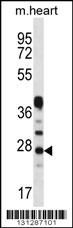
CRYBA1 Antibody (Center) (Cat# 102-11533) western blot analysis in mouse heart tissue lysates (35ug/lane).This demonstrates the CRYBA1 antibody detected the CRYBA1 protein (arrow).
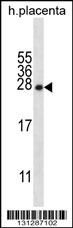
CRYBA1 Antibody (Center) (Cat# 102-11533) western blot analysis in human placenta tissue lysates (35ug/lane).This demonstrates the CRYBA1 antibody detected the CRYBA1 protein (arrow).
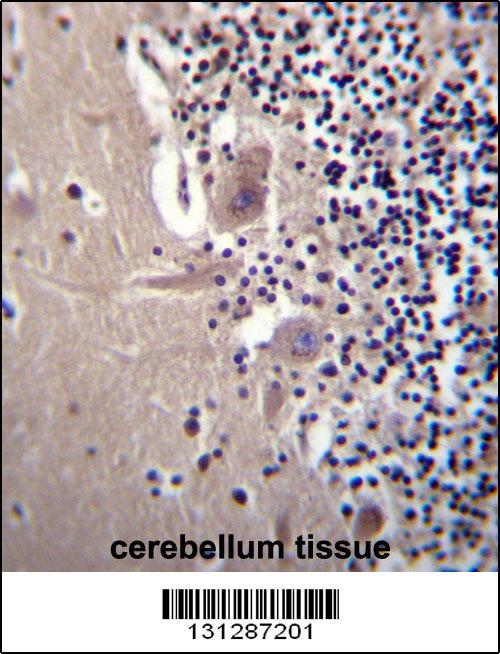
CRYBA1 Antibody (Center) (Cat# 102-11533)immunohistochemistry analysis in formalin fixed and paraffin embedded human cerebellum tissue followed by peroxidase conjugation of the secondary antibody and DAB staining.This data demonstrates the use of CRYBA1 Antibody (Center) for immunohistochemistry. Clinical relevance has not been evaluated.

Antigen Source

HUMAN

Storage/Stability

2-8°C (short-term); -20°C (long-term)
Expiration:
12 months from the date of shipment when stored properly.