Introduction
Serine/threonine kinase which acts as an essential component of the MAP kinase signal transduction pathway. MAPK1/ERK2 and MAPK3/ERK1 are the 2 MAPKs which play an important role in the MAPK/ERK cascade. They participate also in a signaling cascade initiated by activated KIT and KITLG/SCF. Depending on the cellular context, the MAPK/ERK cascade mediates diverse biological functions such as cell growth, adhesion, survival and differentiation through the regulation of transcription, translation, cytoskeletal rearrangements. The the MAPK/ERK cascade plays also a role in initiation and regulation of meiosis, mitosis, and postmitotic functions in differentiated cells by phosphorylating a number of transcription factors. About 160 substrates have already been discovered for ERKs. Many of these substrates are localized in the nucleus, and seem to participate in the regulation of transcription upon stimulation. However, other substrates are found in the cytosol as well as in other cellular organelles, and those are responsible for processes such as translation, mitosis and apoptosis. Moreover, the MAPK/ERK cascade is also involved in the regulation of the endosomal dynamics, including lysosome processing and endosome cycling through the perinuclear recycling compartment (PNRC); as well as in the fragmentation of the Golgi apparatus during mitosis. The substrates include transcription factors (such as ATF2, BCL6, ELK1, ERF, FOS, HSF4 or SPZ1), cytoskeletal elements (such as CANX, CTTN, GJA1, MAP2, MAPT, PXN, SORBS3 or STMN1), regulators of apoptosis (such as BAD, BTG2, CASP9, DAPK1, IER3, MCL1 or PPARG), regulators of translation (such as EIF4EBP1) and a variety of other signaling-related molecules (like ARHGEF2, FRS2 or GRB10). Protein kinases (such as RAF1, RPS6KA1/RSK1, RPS6KA3/RSK2, RPS6KA2/RSK3, RPS6KA6/RSK4, SYK, MKNK1/MNK1, MKNK2/MNK2, RPS6KA5/MSK1, RPS6KA4/MSK2, MAPKAPK3 or MAPKAPK5) and phosphatases (such as DUSP1, DUSP4, DUSP6 or DUSP16) are other substrates which enable the propagation the MAPK/ERK signal to additional cytosolic and nuclear targets, thereby extending the specificity of the cascade.
Specificity
Other Names
MAPK3;ERK1; PRKM3; Mitogen-activated protein kinase 3; Mitogen-activated protein kinase 3; ERT2; Mitogen-activated protein kinase 3; Extracellular signal-regulated kinase 1; Mitogen-activated protein kinase 3; Insulin-stimulated MAP2 kinase; Mitogen-activated protein kinase 3; MAP kinase isoform p44; Mitogen-activated protein kinase 3; Microtubule-associated protein 2 kinase; Mitogen-activated protein kinase 3; p44-ERK1;Mitogen-activated protein kinase 1, MAP kinase 1; MAPK 1; ERT1; Extracellular signal-regulated kinase 2, ERK-2; MAP kinase isoform p42, p42-MAPK; Mitogen-activated protein kinase 2, MAP kinase 2; MAPK 2;MAPK1; ERK2;PRKM1; PRKM2
Format
Type
Mouse Monoclonal Antibody (Mab)
Calculated Molecular Weight (Da)
43136
Recommended Dilutions
WB: 1:1000
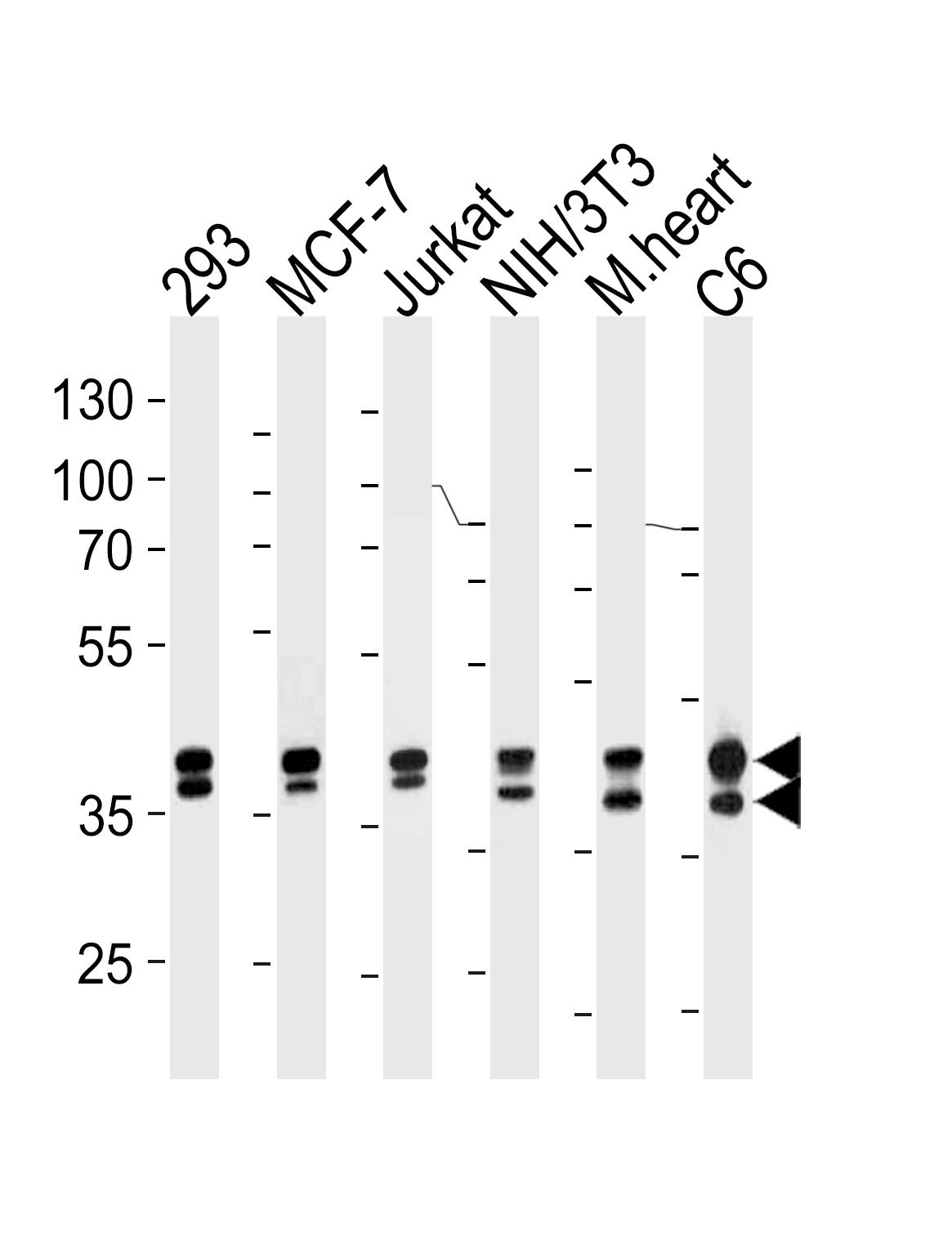 | Erk1/2 Antibody (Cat# 102-10402) western blot analysis in 293,MCF-7,Jurkat,mouse NIH/3T3,rat C6 cell line and mouse heart lysates (35ug/lane).This demonstrates the Erk1/2 antibody detected the Erk1/2 protein (arrow). |
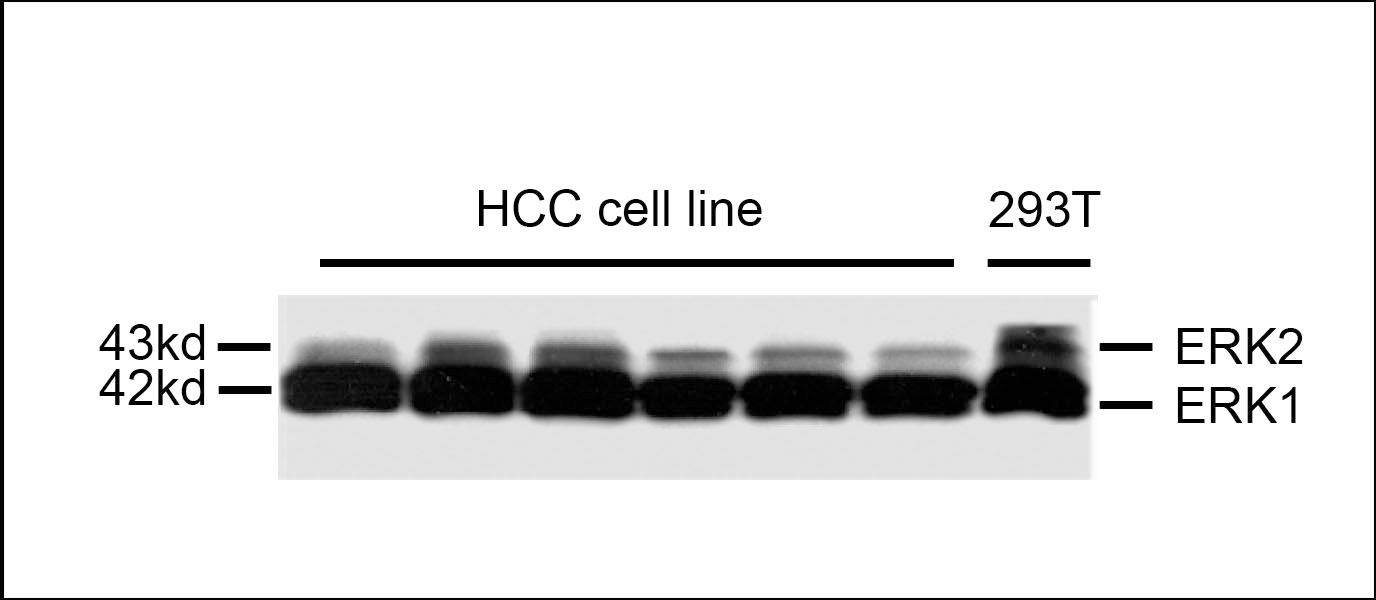 | Western blot analysis of extracts from HCC cell line and 293T cells, using mouse monoclonal antibody Erk1/2 Antibody (Cat# 102-10402). |
Storage/Stability
2-8°C (short-term); -20°C (long-term)
Expiration:
12 months from the date of shipment when stored properly.