RayBiotech

3607 Parkway Ln Ste 200 Norcross, Georgia 30092

www.RayBiotech.com | info@raybiotech.com

770-729-2992 | +1-888-494-8555

ISO 13485:2016 cGMP

Anti-hCdk7-T170 Antibody

Catalog #: 102-25365

Rabbit Anti-hCdk7-T170 Antibody, 200 µl

Product Description

Specifications

Size200 µL
Estimated Lead Time1-2 weeks
SpeciesHuman
Host SpeciesRabbit
Accession Number
P50613|Q03147
Gene Id
1022
Gene Symbols
CDK7
Protein Name / Synonyms
Cyclin-dependent kinase 7, 2.7.11.22, 2.7.11.23, 39 kDa protein kinase, p39 Mo15, CDK-activating kinase 1, Cell division protein kinase 7, Serine/threonine-protein kinase 1, TFIIH basal transcription factor complex kinase subunit, CDK7, CAK, CAK1, CDKN7, MO15, STK1
ClonalityPolyclonal
CloneRB59665
IsotypeKappa, Rabbit
Recommended ApplicationsWestern Blotting
Shipping TypeBlue ice
Storage-20°C

Description

Introduction

Serine/threonine kinase involved in cell cycle control and in RNA polymerase II-mediated RNA transcription. Cyclin- dependent kinases (CDKs) are activated by the binding to a cyclin and mediate the progression through the cell cycle. Each different complex controls a specific transition between 2 subsequent phases in the cell cycle. Required for both activation and complex formation of CDK1/cyclin-B during G2-M transition, and for activation of CDK2/cyclins during G1-S transition (but not complex formation). CDK7 is the catalytic subunit of the CDK-activating kinase (CAK) complex. Phosphorylates SPT5/SUPT5H, SF1/NR5A1, POLR2A, p53/TP53, CDK1, CDK2, CDK4, CDK6 and CDK11B/CDK11. CAK activates the cyclin-associated kinases CDK1, CDK2, CDK4 and CDK6 by threonine phosphorylation, thus regulating cell cycle progression. CAK complexed to the core-TFIIH basal transcription factor activates RNA polymerase II by serine phosphorylation of the repetitive C-terminal domain (CTD) of its large subunit (POLR2A), allowing its escape from the promoter and elongation of the transcripts. Phosphorylation of POLR2A in complex with DNA promotes transcription initiation by triggering dissociation from DNA. Its expression and activity are constant throughout the cell cycle. Upon DNA damage, triggers p53/TP53 activation by phosphorylation, but is inactivated in turn by p53/TP53; this feedback loop may lead to an arrest of the cell cycle and of the transcription, helping in cell recovery, or to apoptosis. Required for DNA-bound peptides-mediated transcription and cellular growth inhibition.

Other Information

Antigen Type
Synthesized Peptide
Format
Purified polyclonal antibody supplied in PBS with 0.09% (W/V) sodium azide. This antibody is purified through a protein A column, followed by peptide affinity purification.
Calculated Molecular Weight (Da)
39038
Antigen Source
Human

Images

WB (1:1000)

All lanes : Anti-hCdk7-T170 at 1:1000 dilution Lane 1: Hela whole cell lysate Lane 2: MCF-7 whole cell lysate Lane 3: A431 whole cell lysate Lane 4: A549 whole cell lysate Lysates/proteins at 20 µg per lane. Secondary Goat Anti-Rabbit IgG, (H+L), Peroxidase conjugated at 1/10000 dilution. Predicted band size : 39 kDa Blocking/Dilution buffer: 5% NFDM/TBST.
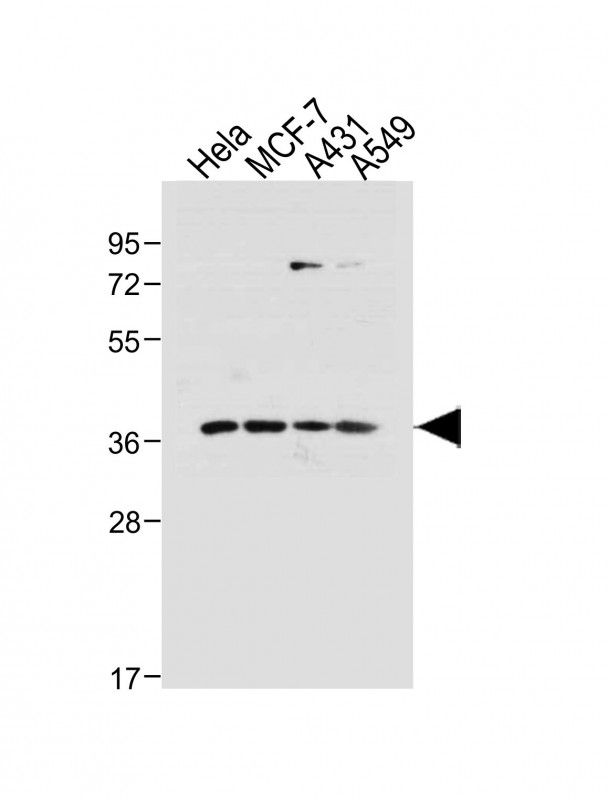
WB

Storage/Stability

2-8°C (short-term); -20°C (long-term)
Expiration:
12 months from the date of shipment when stored properly.