Anti-hHR23b Antibody
Catalog #: 102-26570
Mouse Anti-hHR23b Antibody, 100 µl
Product Description
Specifications
| Size | 100 µL |
| Estimated Lead Time | 1-2 weeks |
| Species | Human, Mouse |
| Host Species | Mouse |
| Accession Number | P54727 |
| Gene Id | 5887 |
| Gene Symbols | RAD23B |
| Protein Name / Synonyms | hHR 23b;hHR23B;HR 23B;HR23B;mHR 23B;mHR23B;P58;RAD 23B;RAD23 (S. cerevisiae) homolog |
| Clonality | Monoclonal |
| Recommended Applications | Western Blotting, ICC, IHC |
| Shipping Type | Blue ice |
| Storage | -20°C |
Description
Introduction
Multiubiquitin chain receptor involved in modulation of proteasomal degradation. Binds to polyubiquitin chains. Proposed to be capable to bind simultaneously to the 26S proteasome and to polyubiquitinated substrates and to deliver ubiquitinated proteins to the proteasome. May play a role in endoplasmic reticulum- associated degradation (ERAD) of misfolded glycoproteins by association with PNGase and delivering deglycosylated proteins to the proteasome. The XPC complex is proposed to represent the first factor bound at the sites of DNA damage and together with other core recognition factors, XPA, RPA and the TFIIH complex, is part of the pre-incision (or initial recognition) complex. The XPC complex recognizes a wide spectrum of damaged DNA characterized by distortions of the DNA helix such as single-stranded loops, mismatched bubbles or single-stranded overhangs. The orientation of XPC complex binding appears to be crucial for inducing a productive NER. XPC complex is proposed to recognize and to interact with unpaired bases on the undamaged DNA strand which is followed by recruitment of the TFIIH complex and subsequent scanning for lesions in the opposite strand in a 5'-to-3' direction by the NER machinery. Cyclobutane pyrimidine dimers (CPDs) which are formed upon UV-induced DNA damage esacpe detection by the XPC complex due to a low degree of structural perurbation. Instead they are detected by the UV-DDB complex which in turn recruits and cooperates with the XPC complex in the respective DNA repair. In vitro, the XPC:RAD23B dimer is sufficient to initiate NER; it preferentially binds to cisplatin and UV-damaged double-stranded DNA and also binds to a variety of chemically and structurally diverse DNA adducts. XPC:RAD23B contacts DNA both 5' and 3' of a cisplatin lesion with a preference for the 5' side. XPC:RAD23B induces a bend in DNA upon binding. XPC:RAD23B stimulates the activity of DNA glycosylases TDG and SMUG1.
Other Information
Antigen Type
Recombinant Protein
Images
WB (1:1000)
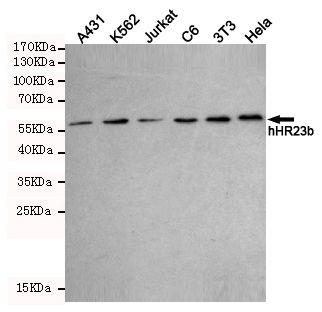
Western blot detection of hHR23b in A431,K562,Jurkat,C6,3T3 and Hela cell lysates using hHR23b mouse mAb (1:1000 diluted).Predicted band size:58KDa.Observed band size:58KDa.Exposure time:5min.
ICC (1:100)
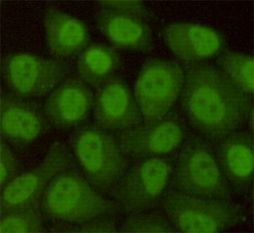
Immunocytochemistry staining of HeLa cells fixed with 4% Paraformaldehyde and using anti-hHR23b antibody (dilution 1:100).
IHC (1:100)
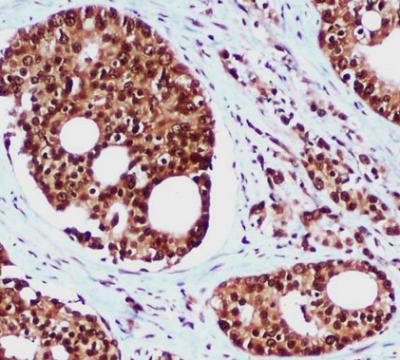
Immunohistochemical analysis of paraffin-embedded Prostate Cancer using hHR23b mouse mAb (1/100 dilution).Antigen retrieval was performed by pressure cooking in citrate buffer (pH 6.0).
Storage/Stability
2-8°C (short-term); -20°C (long-term)
Expiration:
12 months from the date of shipment when stored properly.