RayBiotech

3607 Parkway Ln Ste 200 Norcross, Georgia 30092

www.RayBiotech.com | info@raybiotech.com

770-729-2992 | +1-888-494-8555

ISO 13485:2016 cGMP

Anti-P38 (p180/182) (Phospho) Antibody

Catalog #: RB-02-0020

Rabbit anti-Human P38 (p180/182) (Phosph) Antibody

Product Description

Specifications

Size20 µg, 100 µg, 200 µg, 500 µg
Estimated Lead Time1-2 business days
SpeciesHuman
Specificity
This antibody binds to its immunogen, and did not show any cross reactivity with unrelated antigens in ELISA. Cross reactivity with mouse and rat P38(p180/182)(Phosph) has not yet been tested.
Accession Number
Q16539
Gene Id
1432
Gene Symbols
MAPK14 CSBP CSBP1 CSBP2 CSPB1 MXI2 SAPK2A
ClonalityPolyclonal
Immunogen
The imunogen was synthetic peptide. This antibody was produced from a rabbit immunized with the immunogen. The IgG fraction was purified from rabbit serum followed by Protein A/G affinity chromatography.
Immunogen Sequence
CDDEMTGY(P)VATR
Concentration (lot specific)
1.5 mg/ml
Recommended ApplicationsELISA (recommended work dilution= 1:2, 000)
Reconstitution
Product is supplied as a solution obtained from purified antibody in PBS (pH 7.5) with 50% glycerol without preservatives.
Research AreaAngiogenesis, Cancer, Inflammation
Shipping TypeBlue ice
Storage-20°C

Description

Description

MAPKs (mitogen-activated protein kinases) are serine-threonine kinases that regulate a wide variety of cellular functions. Six groups of MAPK have so far been identified: Extracellular signal-regulated kinases (ERK1, ERK2), c-Jun N-terminal kinases (JNKs), p38 isoforms (MAPK11, MAPK12, MAPK13, MAPK14), ERK5 (MAPK7), ERK3 (MAPK6), ERK4 (MAPK4) and ERK7/8 (MAPK15). ERK 1 and ERK 2 transduce signals from growth factors and are key factors in regulating differentiation and proliferation in many cell types. Upon activation by MEK, ERK1 and 2 translocate to the nucleus where they phosphorylate transcription factors such as Elk1 and downstream kinases such as p90 RSK. JNK 1, 2 and 3 (sometimes known as SAPKs or stress-activated kinases) and the p38 MAPKs (alpha-, beta-, delta and gamma- isoforms) are activated by UV irradiation, inflammatory cytokines and hyperosmolarity. The p38 MAPKs are also activated by lipopolysaccharide. Dysregulation of MAPK kinase pathways has been associated with various diseases including cancer (ERK), neurodegeneration (JNK) and inflammation (p38).

Typical Data

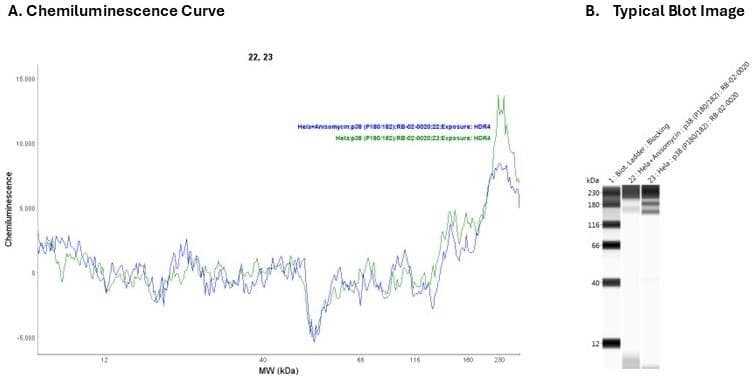
Cell Lysate: Hela + Anisomycin | Secondary Ab: Rabbit | Exposure: HDR | Expected MW (kDa): 41


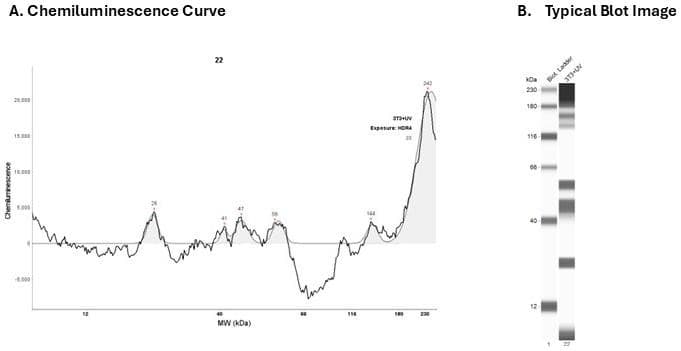
Cell Lysate: 3T3 + UV lysate | Secondary Ab: Rabbit | Exposure: HDR4 | Expected MW (kDa): 43

Storage/Stability

Store at 4°C if intended for use within one month, otherwise, store at -20°C to -80°C. The lyophilized antibody is stable for at least 18 months after the date of receipt when stored at -20°C to -80°C. After reconstitution, it can be aliquoted and stored frozen at -20°C to -80°C in a manual defrost freezer for at least 6 months without detectable loss of activity. Upon reconstitution, the antibody can also be stored for 1 month at 4°C. Please avoid multiple freeze-thaw cycles, as this will lower the activity of the antibody.

Expiration

12 months from the date of shipment when stored properly.

References

  • Raingeaud J, et al.. (1996) MKK3- and MKK6-regulated gene expression is mediated by the p38 mitogen-activated protein kinase signal transduction pathway. Mol Cell Biol. 16(3):1247-55.
  • Xu P and Derynck R. Direct activation of TACE-mediated ectodomain shedding by p38 MAP kinase regulates EGF receptor-dependent cell proliferation. Mol Cell. 37(4):551-66.