Introduction
This intronless gene is thought to have been generated by retrotransposition of a fully processed PCBP-2 mRNA. This gene and PCBP-2 have paralogues (PCBP3 and PCBP4) which are thought to have arisen as a result of duplication events of entire genes. The protein encoded by this gene appears to be multifunctional. It along with PCBP-2 and hnRNPK corresponds to the major cellular poly(rC)-binding protein. It contains three K-homologous (KH) domains which may be involved in RNA binding. This encoded protein together with PCBP-2 also functions as translational coactivators of poliovirus RNA via a sequence-specific interaction with stem-loop IV of the IRES and promote poliovirus RNA replication by binding to its 5'-terminal cloverleaf structure. It has also been implicated in translational control of the 15-lipoxygenase mRNA, human Papillomavirus type 16 L2 mRNA, and hepatitis A virus RNA. The encoded protein is also suggested to play a part in formation of a sequence-specific alpha-globin mRNP complex which is associated with alpha-globin mRNA stability.
Specificity
Predicted Reactivity
Mouse, Bovine, Rabbit
Other Names
PCBP1; Poly(rC)-binding protein 1; Alpha-CP1; Heterogeneous nuclear ribonucleoprotein E1; Nucleic acid-binding protein SUB2.3
NCBI Accession #
NP_006187.2
Other Accession #
O19048; P60335; Q5E9A3; NP_006187.2
Format
Type
Peptide Affinity Purified Rabbit Polyclonal Antibody (Pab)
Calculated Molecular Weight (Da)
37498
Recommended Dilutions
WB: 1:1000
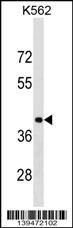 | PCBP1 Antibody (Center)(Cat# 102-14024) western blot analysis in K562 cell line lysates (35ug/lane).This demonstrates the PCBP1 antibody detected the PCBP1 protein (arrow). |
Antigen Source
HUMAN
Storage/Stability
2-8°C (short-term); -20°C (long-term)
Expiration:
12 months from the date of shipment when stored properly.