RayBiotech

3607 Parkway Ln Ste 200 Norcross, Georgia 30092

www.RayBiotech.com | info@raybiotech.com

770-729-2992 | +1-888-494-8555

ISO 13485:2016 cGMP

Anti-Phospho-Tau (pThr231) Antibody

Catalog #: RB-02-0034

Mouse Anti-Human Tau Antibody

Product Description

Specifications

Size20 µg, 100 µg, 200 µg, 500 µg
Estimated Lead Time1-2 business days
SpeciesHuman
Specificity
The antibody secreted by clone 13B10 specifically detected phosphorylated Tau protein derived from human brain tissue. It recognized PHF-tau phosphorylated at Thr231.In both ELISA and WB, this antibody shows no cross-reactivity with other unrelated proteins.
ClonalityMonoclonal
Clone13B10
Immunogen
Immunogen was a synthetic peptide derived from human Tau. This antibody was produced from a hybridoma resulting from the fusion of a mouse myeloma with B cells derived from the immunized mouse. The IgM fraction of cell culture supernatant was purified by affinity chromatography.
Concentration (lot specific)
0.719 mg/ml
Recommended ApplicationsELISA (recommended work dilution= 1:2, 000-5, 000), Western Blotting( recommended work dilution= 5 ug/ml), Immunoprecipitation (recommended work dilution= (mg/ml) Determined by customer)
Reconstitution
Product is supplied as a solution obtained from purified antibody in PBS (pH 7.5) with 50% glycerol without preservatives.
Shipping TypeBlue ice
Storage-20°C

Description

Description

Microtubule-associated protein, tau is abnormally hyperphosphorylated in the brain of patients with Alzheimer's disease, and is the major protein subunit of paired helical filaments. There is also a significant pool of non-paired helical filament abnormally phosphorylated tau in Alzheimer's disease brain. Tau is a family of six isoforms, derived from a single gene by mRNA splicing. Tau protein is produced by a single gene expressed predominantly in neurons. They vary in size from 352-441 amino acides. In Alzheimer disease Tau is hyperphosphorylated, containing 3-4 fold more phosphoate/mole of the protein than the normal tau. Recent investigations show that MARK and PKA phosphorylate several sites within the repeats (notably the KXGS motifs including Ser262, Ser324, and Ser356, plus Ser320); in addition PKA phosphorylates some sites in the flanking domains, notably Ser214. This type of phosphorylation strongly reduces tau's affinity for microtubules, and at the same time inhibits tau's assembly into PHFs (Paired helical filament).

Typical Data

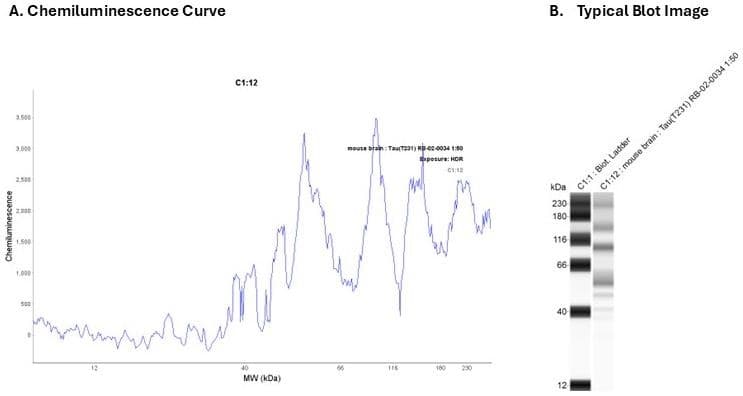
Mouse Brain | Secondary Ab: Mouse | Exposure: HDR | Expected MW (kDa): 78


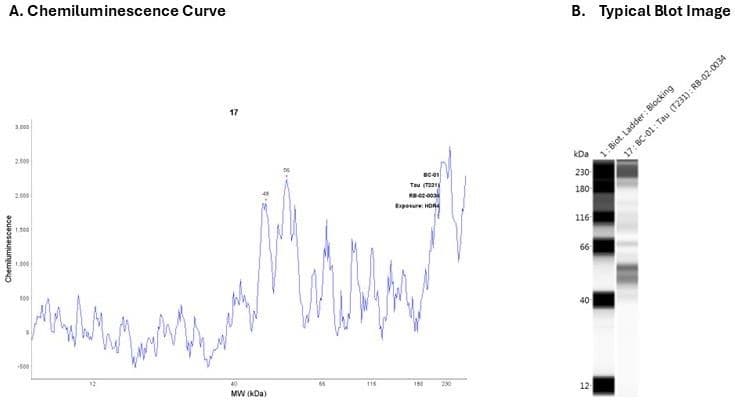
Cell Lysate: BC-01 | Secondary Ab: Mouse | Exposure: HDR | Expected MW (kDa): 78

Storage/Stability

It is recommended to prepare single-use aliquots of this antibody prior to long term storage. A small amount of antibody can be kept at 4°C for daily use. For long term storage, recommend to store at -20°C after adding an equal volume of glycerol in PBS. Antibody will remain active for 1 year. Minimize freezing and thawing when in use.

Expiration

12 months from the date of shipment when stored properly.

References

  • Gong CX, Grundke-Iqbal I, Iqbal K (1994).Dephosphorylation of Alzheimer's disease abnormally phosphorylated tau by protein phosphatase-2A.Neuroscience. 61(4):765-72.
  • Biernat, J., et al. (1992). The switch of tau protein to an Alzheimer-like state includes the phosphorylation of two serine-proline motifs upstream of the microtubule binding region. EMBO J. 11(4), 1593-1597.