RayBiotech

3607 Parkway Ln Ste 200 Norcross, Georgia 30092

www.RayBiotech.com | info@raybiotech.com

770-729-2992 | +1-888-494-8555

ISO 13485:2016 cGMP

Anti-PRL Antibody

Catalog #: 130-00024

Rabbit Anti-Human PRL Antibody

Product Description

Specifications

Size20 µg, 100 µg, 200 µg, 500 µg
Estimated Lead Time1-2 business days
SpeciesHuman
Accession Number
P01236
Gene Id
5617
Gene Symbols
PRL
ClonalityPolyclonal
Immunogen
The immunogen was a synthetic peptide (prolactin). This antibody was produced from a rabbit immunized with this peptide conjugated with KLH. The IgG fraction was purified from rabbit serum by Protein G affinity chromatography.
Immunogen Sequence
CKENEIYPVWSGLPSLQMADEESRLSAYYN
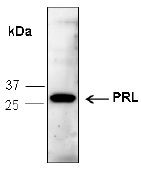
Recommended ApplicationsELISA (recommended work dilution= 1: 64, 000), Western Blotting (recommended work dilution= 1:1, 000), (see image) Western blot analysis of recombinant human PRL, using anti-PRL antibody (1 :1, 000)
Reconstitution
Product is supplied as a powder obtained from lyophilization of purified antibody in PBS without preservatives. Reconstitute the antibody with sterile water to a final concentration of 1 mg/ml.
Research AreaAngiogenesis
Shipping TypeAmbient temperature
Storage-20°C

Description

Description

Prolactin (PRL) also known as luteotropic hormone (LTH) is a protein that in humans is encoded by the PRL gene. Prolactin is a peptide hormone discovered by Henry Friesen. Prolactin also acts in a cytokine-like manner and as an important regulator of the immune system. Prolactin has important cell cycle related functions as a growth-, differentiating- and anti-apoptotic factor. As a growth factor binding to cytokine like receptors it has also profound influence on hematopoiesis, angiogenesis and is involved in the regulation of blood clotting through several pathways. Prolactin acts in endocrine, autocrine, and paracrine manner through the prolactin receptor and a large number of cytokine receptors.

Specificity

This antibody can specifically bind to human prolactin. The cross reactivity with mouse and rat prolactin was not tested.

Storage

Store at 4°C if intended for use within one month, otherwise, store at -20°C to -80°C. The lyophilizedantibody is stable for at least 18 months after the date of receipt when stored at -20°C to -80°C. After reconstitution, it can also be aliquoted and stored frozen at -20°C to -80°C in a manual defrost freezer for at least 6 months without detectable loss of activity. Upon reconstitution, the antibody can also be stored for 30 days at 4°C. Please avoid freeze-thaw cycles, as this will lower the activity of the antibody.

References

  • Evans, AM. et al. (1989). "Mapping of prolactin and tumor necrosis factor-beta genes on human chromosome 6p using lymphoblastoid cell deletion mutants". Somat. Cell Mol. Genet. 15 (3): 203–13.
  • Bole-Feysot, C. et al. (1998). "Prolactin (PRL) and its receptor: Actions, signal transduction pathways and phenotypes observed in PRL receptor knockout mice". Endocrine Reviews 19 (3): 225–268.
Expiration:
12 months from the date of shipment when stored properly.