3607 Parkway Ln Ste 200 Norcross, Georgia 30092
www.RayBiotech.com | info@raybiotech.com
770-729-2992 | +1-888-494-8555
ISO 13485:2016 cGMP

3607 Parkway Ln Ste 200 Norcross, Georgia 30092
www.RayBiotech.com | info@raybiotech.com
770-729-2992 | +1-888-494-8555
ISO 13485:2016 cGMP
Catalog #: 102-14696
Rabbit Anti-Human PROX1 (C-term) Antibody, 400 ul
| Size | 400 µL |
| Estimated Lead Time | 1-2 weeks |
| Species | Human |
| Host Species | Rabbit |
| Accession Number | Q92786 |
| Gene Id | 5629 |
| Gene Symbols | PROX1 |
| Protein Name / Synonyms | PROX1 (C-term) |
| Clonality | Polyclonal |
| Preparation | This PROX1 antibody is generated from rabbits immunized with a KLH conjugated synthetic peptide between 492-522 amino acids from the C-terminal region of human PROX1. |
| Concentration (lot specific) | 2.0 mg/ml |
| Recommended Applications | Western Blotting, IF |
| Research Area | Angiogenesis, Cardiovascular Disease |
| Shipping Type | Blue ice |
| Storage | -20°C |
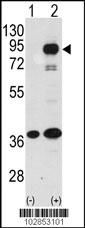 | Western blot analysis of PROX1 (arrow) using rabbit polyclonal PROX1 Antibody (Cat# 102-14696). 293 cell lysates (2 ug/lane) either nontransfected (Lane 1) or transiently transfected with the PROX1 gene (Lane 2) (Origene Technologies). |
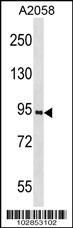 | PROX1 Antibody (K507) (Cat# 102-14696) western blot analysis in A2058 cell line lysates (35ug/lane).This demonstrates the PROX1 antibody detected the PROX1 protein (arrow). |
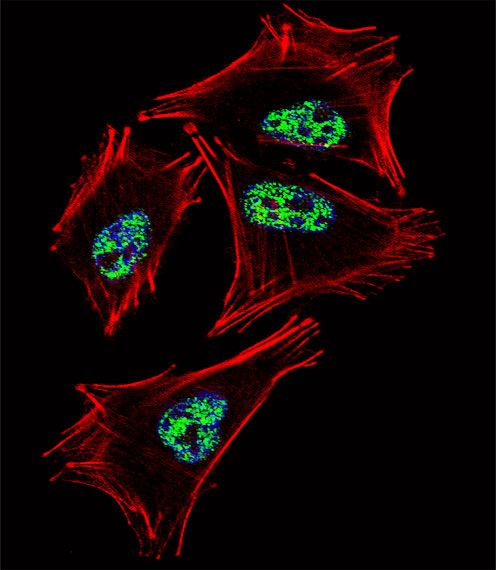 | Fluorescent confocal image of A2058 cell stained with PROX1 Antibody (C-term)(Cat# 102-14696).A2058 cells were fixed with 4% PFA (20 min), permeabilized with Triton X-100 (0.1%, 10 min), then incubated with PROX1 primary antibody (1:25, 1 h at 37°). For secondary antibody, Alexa Fluor® 488 conjugated donkey anti-rabbit antibody (green) was used (1:400, 50 min at 37°).Cytoplasmic actin was counterstained with Alexa Fluor® 555 (red) conjugated Phalloidin (7units/ml, 1 h at 37°). Nuclei were counterstained with DAPI (blue) (10 µg/ml, 10 min). PROX1 immunoreactivity is localized to Nucleus significantly. |
Your cart is empty.