Introduction
SIGLECs are members of the immunoglobulin superfamily that are expressed on the cell surface. Most SIGLECs have one or more cytoplasmic immune receptor tyrosine-based inhibitory motifs (ITIM). SIGLECs are typically expressed on cells of the innate immune system, with the exception of the B-cell expressed SIGLEC6. Sequence analysis predicted that the 697-amino acid SIGLEC10 protein contains a signal peptide, an N-terminal V-set Ig-like domain and four C2-set Ig-like domains, five potential N-linked glycosylation sites, a transmembrane region, and a 126-residue cytoplasmic tail with 3 putative ITIMs. Northern blot analysis detected a major 3.0-kb SIGLEC10 transcript, with highest levels in spleen, lymph node, blood leukocytes, and appendix. Little or no expression was observed in pancreas, thyroid, and testis. Flow cytometric analysis demonstrated eosinophil-specific expression of SIGLEC10, but at a lower level than that of SIGLEC8. Expression was also detected on monocytes and a CD16-positive/CD56-negative natural killer-like lymphocyte population. After sialidase treatment, which is necessary for unmasking the sialic acid-binding site on SIGLECs interacting with cell surface sialic acids, cells expressing SIGLEC10 bound to red blood cells. Immunoprecipitation analysis indicated expression of a 100- to 120-kD monomeric protein, higher than the predicted molecular mass, suggesting that SIGLEC10 is glycosylated.
Other Information
NCBI Accession #
NP_003821.1
Antigen Type
Synthetic Peptide
Format
Purified polyclonal antibody supplied in PBS with 0.09% (W/V) sodium azide. This antibody is purified through a protein A column, followed by peptide affinity purification.
Calculated Molecular Weight (Da)
60715
Images
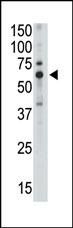
WB (1:1000)
The anti-Siglec5 C-term Pab (Cat. #102-22220) is used in Western blot to detect Siglec5 in mouse liver tissue lysate.
Storage/Stability
2-8°C (short-term); -20°C (long-term)
Expiration:
12 months from the date of shipment when stored properly.