RayBiotech

3607 Parkway Ln Ste 200 Norcross, Georgia 30092

www.RayBiotech.com | info@raybiotech.com

770-729-2992 | +1-888-494-8555

ISO 13485:2016 cGMP

Anti-SLC4A1 Antibody

Catalog #: 144-64915

SLC4A1 pAb

Product Description

Specifications

Size20 µL, 100 µL
Estimated Lead Time1-2 weeks
SpeciesHuman, Mouse, Rat
Host SpeciesRabbit
Accession Number
P02730
Gene Id
6521
Gene Symbols
SLC4A1
Protein Name / Synonyms
DI, FR, SW, WD, WR, AE1, CHC, SAO, WD1, BND3, EPB3, SPH4, CD233, EMPB3, RTA1A
IsotypeIgG
Purity
Affinity purification
BuffersPBS with 0.02% sodium azide, 50% glycerol, pH7.3
Recommended ApplicationsWestern Blotting
Shipping TypeBlue ice
Storage-20°C

Description

Background

The protein encoded by this gene is part of the anion exchanger (AE) family and is expressed in the erythrocyte plasma membrane, where it functions as a chloride/bicarbonate exchanger involved in carbon dioxide transport from tissues to lungs. The protein comprises two domains that are structurally and functionally distinct. The N-terminal 40kDa domain is located in the cytoplasm and acts as an attachment site for the red cell skeleton by binding ankyrin. The glycosylated C-terminal membrane-associated domain contains 12-14 membrane spanning segments and carries out the stilbene disulphonate-sensitive exchange transport of anions. The cytoplasmic tail at the extreme C-terminus of the membrane domain binds carbonic anhydrase II. The encoded protein associates with the red cell membrane protein glycophorin A and this association promotes the correct folding and translocation of the exchanger. This protein is predominantly dimeric but forms tetramers in the presence of ankyrin. Many mutations in this gene are known in man, and these mutations can lead to two types of disease: destabilization of red cell membrane leading to hereditary spherocytosis, and defective kidney acid secretion leading to distal renal tubular acidosis. Other mutations that do not give rise to disease result in novel blood group antigens, which form the Diego blood group system. Southeast Asian ovalocytosis (SAO, Melanesian ovalocytosis) results from the heterozygous presence of a deletion in the encoded protein and is common in areas where Plasmodium falciparum malaria is endemic. One null mutation in this gene is known, resulting in very severe anemia and nephrocalcinosis.

Dilutions

WB 1:500 - 1:2000

Format

Calculated MW
Observed MW

Immunogen

Recombinant fusion protein containing a sequence corresponding to amino acids 1-353 of human SLC4A1 (NP_000333.1).

Modification

Storage

Store at -20°. Avoid freeze / thaw cycles.

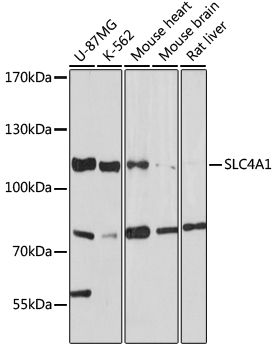
Images

Western blot

Expiration:
12 months from the date of shipment when stored properly.