3607 Parkway Ln Ste 200 Norcross, Georgia 30092
www.RayBiotech.com | info@raybiotech.com
770-729-2992 | +1-888-494-8555
ISO 13485:2016 cGMP

3607 Parkway Ln Ste 200 Norcross, Georgia 30092
www.RayBiotech.com | info@raybiotech.com
770-729-2992 | +1-888-494-8555
ISO 13485:2016 cGMP
Catalog #: 130-10059
Mouse Anti-Human VEGF Antibody
| Size | 20 µg, 100 µg, 200 µg, 500 µg |
| Estimated Lead Time | 1-2 business days |
| Species | Human |
| Accession Number | NP_001165097 |
| Clonality | Monoclonal |
| Clone | A7-E11-G2 |
| Immunogen | Immunogen was recombinant protein derived from VEGF. This antibody was produced from a hybridoma resulting from the fusion of a mouse myeloma with B cells obtained from a mouse immunized with the immunogen. The IgG fraction of tissue culture supernatant was purified by Protein G/A affinity chromatography. |
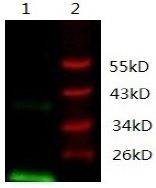
| Recommended Applications | ELISA (recommended work dilution= 6.25 ng/ml ), Western Blotting (recommended work dilution= 1:2000 ), (see image) Immunodetection Analysis: Representative blot from a previous lot. Lane 1, recombinant protein VEGF, Lane 2, protein marker. The membrane blot was probed with antiVEGF primary antibody ( 0.5 µg/ ml ). Proteins were visualized using a donkey anti-mouse secondary antibody conjugated to IRDye 800CW detection system. |
| Antigen Catalog Number | 230-00012 |
| Reconstitution | Product is supplied as a powder obtained from lyophilization of purified antibody in PBS without preservatives. Reconstitute the antibody with sterile water to a final concentration of 1 mg/ml. |
| Research Area | Angiogenesis, Cardiovascular Disease, Vascular Biology |
| Shipping Type | Ambient temperature |
| Storage | -20°C |
Your cart is empty.