Your cart is empty.
Biosimilar development requires more than demonstrating analytical similarity and comparable pharmacokinetics. A key regulatory and scientific requirement is establishing immunogenicity comparability between a biosimilar and its reference product. Anti-drug antibody (ADA) and drug antibody (DA) testing plays a central role in this process, providing data that informs safety, efficacy, and clinical interpretation across development stages.
As biosimilar pipelines expand and competition intensifies, robust ADA and DA testing has evolved from a regulatory obligation into a strategic differentiator.
Understanding immunogenicity risk in biosimilars
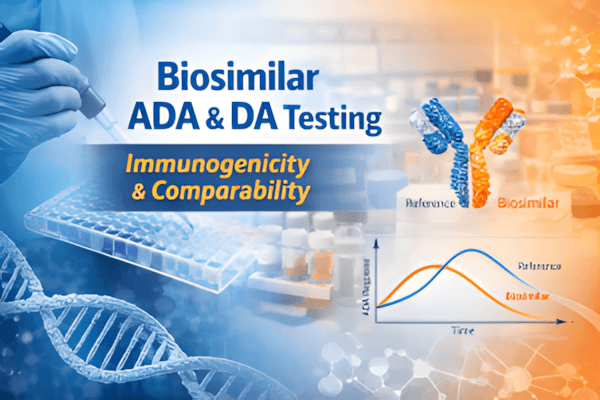
Even minor differences in manufacturing processes, formulation, or route of administration can affect immune responses to biologic therapies. Regulatory agencies therefore expect biosimilar sponsors to assess whether these differences result in meaningful changes in immunogenicity.
ADA and DA assays are used to evaluate:
Well-designed biosimilar immunogenicity testing supports conclusions of biosimilarity while minimizing the risk of regulatory questions or delays in clinical development.
The complementary role of ADA and DA assays in biosimilar comparability
In biosimilar comparability studies, ADA assays can detect antibodies generated against both the biosimilar and the reference product. Comparing ADA incidence rates, antibody titers, and temporal immune response patterns helps establish whether immunogenicity profiles are aligned between products. Comparable ADA profiles strengthen confidence in biosimilarity and help contextualize any observed clinical or pharmacokinetic (PK) differences.
DA assays, which measure circulating drug levels, are critical for interpreting ADA findings. These assays support pharmacokinetic and exposure–response analyses, evaluation of ADA-related effects on drug clearance, and bridging/comparability assessments. Together, ADA and DA assays provide a comprehensive view of immunogenicity and its clinical impact in biosimilar programs.
ADA and DA testing for IV-to-subcutaneous biosimilar transitions
An increasing number of biosimilar programs now include intravenous (IV) to subcutaneous (SC) transitions to reduce treatment burden and improve patient convenience. However, changes in route of administration can influence both drug exposure and immune responses, making immunogenicity assessment particularly important.
In these programs, ADA and DA testing is commonly used to support:
Early planning of biosimilar immunogenicity testing is especially important for programs pursuing SC delivery to ensure data consistency across studies.
Regulatory expectations for biosimilar ADA and DA assays
Regulatory agencies expect ADA and DA assays used in biosimilar programs to be sensitive, specific, and fit for purpose, with appropriate validation or qualification across development stages. Defining assay strategy early helps maintain consistency, support data interpretation, and avoid the need for mid-program changes that can complicate regulatory submissions.
Aligning ADA and DA strategy with biosimilar success
Successful biosimilar development requires alignment across strategy, CMC, clinical, and regulatory teams. Establishing a clear ADA and DA strategy early can reduce immunogenicity-related risk, support efficient regulatory interactions, and enable smoother lifecycle and route-of-administration transitions.
Learn more about ADA and DA assay solutions and bioanalytical support for biosimilar immunogenicity and comparability studies:
Frequently Asked Questions
ADA and DA assays are required in biosimilar development to demonstrate immunogenicity comparability between the biosimilar and the reference product. Regulatory agencies expect sponsors to assess whether anti-drug antibody incidence, magnitude, and clinical impact are similar, as differences may affect safety, efficacy, or pharmacokinetics.
ADA assays detect immune responses directed against the biosimilar and the reference product. They are used to compare ADA incidence and prevalence, antibody titers, and neutralizing potential (when applicable). Consistent ADA profiles help support the conclusion of biosimilarity.
DA assays measure circulating drug levels and are essential for interpreting ADA results in biosimilar studies. Changes in drug exposure may indicate clinically meaningful immunogenicity differences, making DA assays a key component of pharmacokinetic, exposure–response, and comparability analyses.
Yes. When a biosimilar program includes an IV-to-subcutaneous transition, ADA and DA assays are commonly used to support bridging and comparability studies. Route-of-administration changes can influence immunogenicity and exposure, requiring careful assessment to maintain biosimilarity.
Yes. Many biosimilar developers use commercial, ready-to-use ADA and DA assay kits when they are well-characterized, reproducible, and suitable for the target molecule. These kits can reduce development time while maintaining analytical rigor, particularly in early or mid-stage programs.
Regulators expect ADA and DA assays to be sensitive, specific, validated or appropriately qualified, and suitable for detecting differences between products. Assay selection should be justified within the context of the biosimilar’s mechanism of action, clinical use, and development stage.
ADA and DA testing strategy should be defined early in biosimilar development, ideally before clinical study initiation. Early planning helps avoid assay changes mid-program, supports consistent data interpretation, and reduces the risk of regulatory questions or delays.
Yes. RayBiotech offers a portfolio of ADA and DA assay kits commonly used in biosimilar programs, along with custom assay development and bioanalytical services. These solutions support immunogenicity assessment, pharmacokinetic interpretation, and comparability studies across development stages.
Yes. RayBiotech’s ADA and DA assay kits are designed for use in both CRO and sponsor laboratories, making them suitable for outsourced, hybrid, or fully in-house biosimilar development models.