Introduction
RayBio® Acetylated-Histone H2AX ELISA kit is a very rapid, convenient and sensitive assay kit that can monitor the activation or function of important biological pathways in human, mouse and rat cell lysates. By determining Acetylated Histone H2AX protein in your experimental model system, you can verify pathway activation in your cell lysates. You can simultaneously measure numerous different cell lysates without spending excess time and effort in performing a Western Blotting analysis.
This Sandwich ELISA kit is an in vitro enzyme-linked immunosorbent assay for the measurement of human, mouse and rat Acetylated-Histone H2AX. An anti-pan Histone H2AX antibody has been coated onto a 96-well plate. Samples are pipetted into the wells and Histone H2AX present in a sample is bound to the wells by the immobilized antibody. The wells are washed and rabbit anti- Acetyl Lysine antibody is used to detect Acetylated Histone H2AX. After washing away unbound antibody, HRP-conjugated anti-rabbit IgG is pipetted to the wells. The wells are again washed, a TMB substrate solution is added to the wells and color develops in proportion to the amount of Acetylated Histone H2AX bound. The Stop Solution changes the color from blue to yellow, and the intensity of the color is measured at 450 nm.
Product Features
- Rapidly measures acetylated protein in lysates
- Screen numerous different cell lysates without performing a Western Blot analysis
- Minimal hands-on time, convenient, and non-radioactive material
Application Notes
Kit Components
- Pre-Coated 96-well Strip Microplate
- Wash Buffer
- Assay Diluent
- Anti-Acetylated Antibody
- HRP-Conjugated Secondary Antibody
- TMB One-Step Substrate
- Stop Solution
- Lysis Buffer
- Positive Control Sample
Other Materials Required
- Distilled or deionized water
- 100 ml and 1 liter graduated cylinders
- Tubes to prepare sample dilutions
- Protease and Phosphatase inhibitors
- Precision pipettes to deliver 2 µl to 1 ml volumes
- Adjustable 1-25 ml pipettes for reagent preparation
- Benchtop rocker or shaker
- Microplate reader capable of measuring absorbance at 450 nm
Protocol Outline
- Prepare all reagents and samples as instructed in the manual.
- Add 100 µl of sample or positive control to each well.
- Incubate 2.5 h at RT or O/N at 4 °C.
- Add 100 µl of prepared primary antibody to each well.
- Incubate 1 h at RT.
- Add 100 µl of prepared 1X HRP-Streptavidin to each well.
- Incubate 1 h at RT.
- Add 100 µl of TMB One-Step Substrate Reagent to each well.
- Incubate 30 min at RT.
- Add 50 µl of Stop Solution to each well.
- Read at 450 nm immediately.
Typical Data
Positive Control
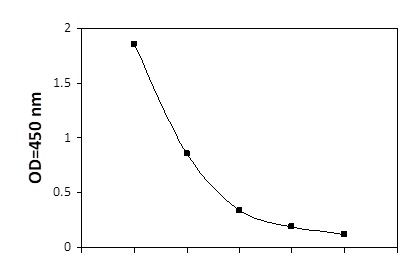
COS cells were treated with Trichostatin A (TSA). Solubilize cells at 4 x 10
7 cells/ml in Cell Lysate Buffer. Serial dilutions of lysates were analyzed in this ELISA. Please see step 3 of Part VI Reagent Preparation for detail.
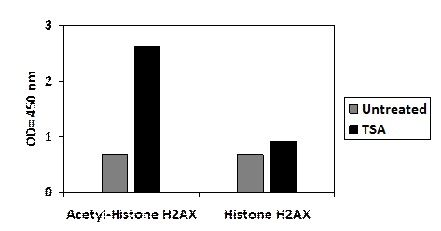
TSA Stimulation of NIH/3T3 Cell Line
NIH/3T3 cells were treated or untreated with TSA. Cell lysates were analyzed using this ELISA and Western Blot.
Storage/Stability
Upon receipt, the kit should be stored at â20°C. Please use within 6 months from the date of shipment. After initial use, Wash Buffer Concentrate (Item B), Assay Diluent (Item E), TMB One-Step Substrate Reagent (Item H), Stop Solution (Item I) and Cell Lysate Buffer (Item J) should be stored at 4°C to avoid repeated freeze-thaw cycles. Return unused wells to the pouch containing desiccant pack, reseal along entire edge, and store at â20°C. Item D, store at 2-8°C for up to one month (store at -20°C for up to 6 months, avoid repeated freeze-thaw cycles). Reconstituted Positive Control (Item K) should be stored at -70°C.