Introduction
NF-Y, also known as CBF, CP1, or YEBP, is a trimeric transcription factor which binds to the CCAAT box within promoters of regulated genes. NF-Y is composed of three subunits including NF-YA, NF-κB and NF-YC, all of which are required for DNA-binding. Each subunit contains an evolutionarily conserved region at the C-terminus of human NF-YA, central region of NF-κB, and the N-terminus of NF-YC, with more than 70% identities across species. Upon stimulation, NF-κB interacts with NF-YC to form a dimer complex. Subsequently, the NF-YA subunit associates with NF-κB/NF-YC. The resulting trimer can then bind to DNA with high specificity and affinity. The CCAAT box corresponding with NF-Y binding is one of the most common elements present in promoters of a wide variety of eukaryotic genes related to developmental control, tissue specificity, housekeeping, inducible cell-cycle regulation, antigen presentation and cholesterol metabolism. Therefore, NF-Y is very important for cellular homeostasis because of its central place in the regulation of large gene families. In addition, NF-Y functionally synergizes the transactivation of several neighboring transcription factors by considerably increasing the affinity of the factors for DNA binding. NF-Y binding to DNA is also important for the establishment of histone posttranslational modifications (PTMs) as well as some acetylation of active promoters, through recruitment of relevant enzymes.
Product Features
- Specific transcription factor-DNA binding assay
- Perfect alternative to EMSA
- Easy to perform in an ELISA format
- Non-radioactive assay
- High throughput (96-well plate format)
- Assay can be completed within 5 hours
Application Notes
Kit Components
- 96-well Strip Microplate pre-coated with DNA probes
- DNA Binding Buffer
- Positive Control Sample
- Specific Competitor DNA probe
- Non-specific Competitor DNA probe
- Assay Reagent
- DTT
- Wash Buffer
- Primary Antibody
- HRP-conjugated Secondary Antibody
- Antibody Diluent Buffer
- TMB One-Step Substrate Reagent
- Stop Solution
Other Materials Required
- Distilled or deionized water
- 100 ml and 1 liter graduated cylinders
- Tubes to prepare sample dilutions
- Absorbent paper
- Precision pipettes to deliver 2 µl to 1 ml volumes
- Adjustable 1-25 ml pipettes for reagent preparation
<lIκBenchtop rocker or shaker
- Microplate reader capable of measuring absorbance at 450 nm
Protocol Outline
- Prepare all reagents and samples as instructed in the manual.
- Add 100 µl of sample or positive control to each well.
- Incubate 2 h at RT or O/N at 4 °C.
- Add 100 µl of prepared primary antibody to each well.
- Incubate 1 h at RT.
- Add 100 µl of prepared HRP-secondary antibody to each well.
- Incubate 1 h at RT.
- Add 100 µl of TMB One-Step Substrate Reagent to each well.
- Incubate 30 min at RT.
- Add 50 µl of Stop Solution to each well.
- Read at 450 nm immediately.
Typical Data
Figure 1
Transcription factor assay of NF-YA from nuclear extracts of Jurkat cells or HeLa cells with the RayBio® NF-YA TF Activity Assay Kit.
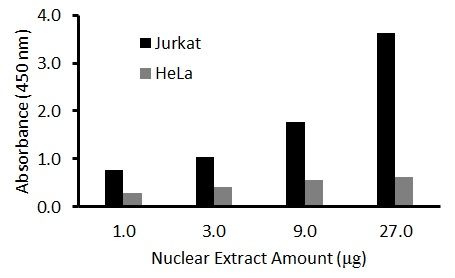
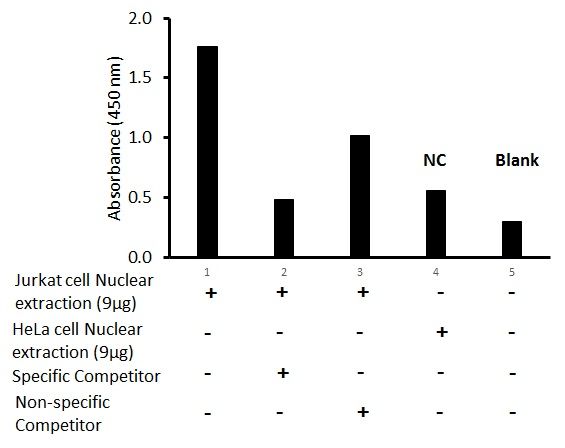
Figure 2
Transcription factor assay of NF-YA from nuclear extracts of Jurkat cells or HeLa cells with the specific competitor or non-specific competitor. The result shows specific binding of NF-YA to the conserved binding site detected by using RayBio® NF-YA TF Activity Assay Kit.
Storage/Stability
Upon receipt, the positive control should be removed and stored at -20° or -80°C. The remainder of the kit can be stored for up to 6 months at 2-8°C from the date of shipment. Opened Microplate Wells or reagents may be stored for up to 1 month at 2° to 8°C. Return unused wells to the pouch containing desiccant pack, reseal along entire edge.
Note: The kit can be used within one year if the whole kit is stored at -20°C upon receipt. Avoid repeated freeze-thaw cycles.