Introduction
Pluripotency and differentiation of embryonic stem (ES) cells is controlled by regulatory genes, which are often transcriptional regulators. The roles of these regulators are to repress or activate patterns of gene expression for normal pluripotent cell development and maintenance, and to mediate permanent phenotypic change during stem cell differentiation. Oct4 is one of these important transcription factors specifically expressed in cells with pluripotent identity. For example, a study with Oct4-null mouse ES cells that differentiated into trophectoderm, the lineage that supplies trophoblast cells for the developing placenta, defined the effects of Oct4 on ES cell self-renewal1. Oct4 belongs to the Octamer class of transcription factors because of recognition of an 8-bp consensus ATGCAAAT DNA sequence. Together with Pit and Unc proteins, Oct proteins define the POU (Pit, Oct and Unc) domain that interact with DNA by binding to the 8-bp sequence. Oct4 contains two DNA-binding domains: the 75-amino-acid POU-specific domain (POUS) and the 60-amino-acid carboxy-terminal POU homeodomain (POUHD).
1Niwa, H., Miyazaki, J. and Smith, A. G. (2000). Quantitative expression of Oct-3/4 defines differentiation, dedifferentiation or self-renewal of ES cells. Nat.Genet. 24, 372-376.
Product Features
- Specific transcription factor-DNA binding assay
- Perfect alternative to EMSA
- Easy to perform in an ELISA format
- Non-radioactive assay
- High throughput (96-well plate format)
- Assay can be completed within 5 hours
Application Notes
Kit Components
- 96-well Strip Microplate pre-coated with DNA probes
- DNA Binding Buffer
- Positive Control Sample
- Specific Competitor DNA probe
- Non-specific Competitor DNA probe
- Assay Reagent
- DTT
- Wash Buffer
- Primary Antibody
- HRP-conjugated Secondary Antibody
- Antibody Diluent Buffer
- TMB One-Step Substrate Reagent
- Stop Solution
Other Materials Required
- Distilled or deionized water
- 100 ml and 1 liter graduated cylinders
- Tubes to prepare sample dilutions
- Absorbent paper
- Precision pipettes to deliver 2 µl to 1 ml volumes
- Adjustable 1-25 ml pipettes for reagent preparation
<lIκBenchtop rocker or shaker
- Microplate reader capable of measuring absorbance at 450 nm
Protocol Outline
- Prepare all reagents and samples as instructed in the manual.
- Add 100 µl of sample or positive control to each well.
- Incubate 2 h at RT or O/N at 4 °C.
- Add 100 µl of prepared primary antibody to each well.
- Incubate 1 h at RT.
- Add 100 µl of prepared HRP-secondary antibody to each well.
- Incubate 1 h at RT.
- Add 100 µl of TMB One-Step Substrate Reagent to each well.
- Incubate 30 min at RT.
- Add 50 µl of Stop Solution to each well.
- Read at 450 nm immediately.
Typical Data
Figure 1
Transcription factor activity assay of Oct4 from nuclear extracts of P19 cells. A. Western-blot result of Oct4 from cytoplasm and nuclear fractions. B. Transcription factor activity assay of Oct4 from nuclear fractions with the RayBio® Oct4 Transcription Factor Activity Assay Kit.
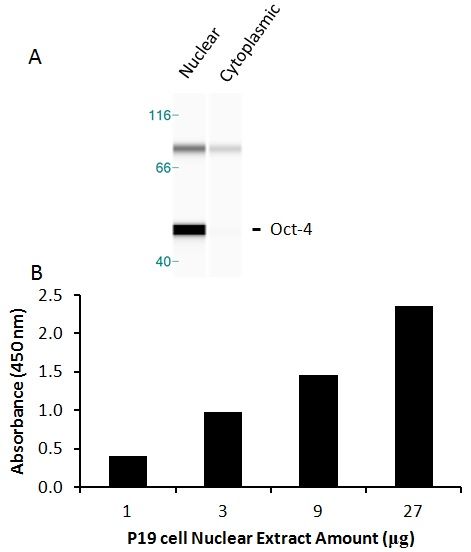
Figure 2
Transcription factor activity assay of Oct4 from nuclear extracts of P19 cells with the specific competitor or non-specific competitor. The result shows specific binding of Oct4 to the conserved DNA binding site.
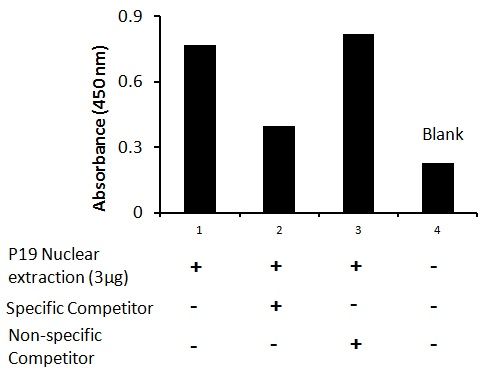
Figure 3
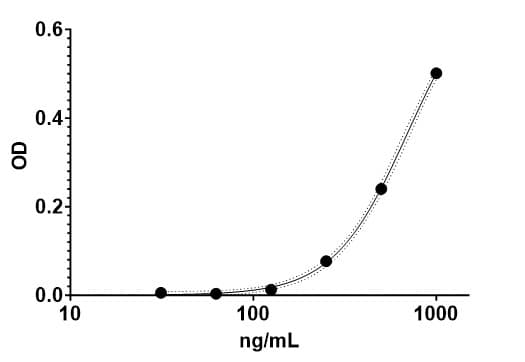
Immobilized DNA containing the OCT4 consensus binding sequence (ATGCAAAT) can bind recombinant human OTC4 (230-00262) with an EC50 of 692.7 ng/mL. Recombinant human OCT4 (230-00262) is available separately and may be used as an additional reference control.
Storage/Stability
Upon receipt, the positive control should be removed and stored at -20° or -80°C. The remainder of the kit can be stored for up to 6 months at 2-8°C from the date of shipment. Opened Microplate Wells or reagents may be stored for up to 1 month at 2° to 8°C. Return unused wells to the pouch containing desiccant pack, reseal along entire edge.
Note: The kit can be used within one year if the whole kit is stored at -20°C upon receipt. Avoid repeated freeze-thaw cycles.


