Introduction
A number of hormones and growth factors have been shown to stimulate target cells via second messenger pathways that in turn regulate the specific nuclear factors. In response to activation of guanine-nucleotide-binding (G)-protein-coupled receptors, the classic intracellular second messenger cyclic AMP accumulates and induces cellular adaption through cAMP response elements (CRE) locating at different gene promoters and transcription factor: CRE binding protein (CREB). In the basal state, the cAMP-dependent protein kinase (PKA) stays in the cytoplasm as an inactive heterotetramer of paired regulatory and catalytic subunits. Induction of cAMP releases the C subunits of PKA into the nucleus and results in phosphorylation of CREB at serine residue 133. This modification enhances the binding of CREB on CRE sequence and promotes recruitment of the transcriptional co-activator CBP and p300 to form a complex which triggers transcription of a number of genes involving different physiologic processes, including intermediary metabolism, cellular proliferation, and neuronal signaling. The CREB family in mammalian systems includes CREB, CREM and ATF-1, which share a 60-amino-acid kinase-inducible domain (KID) containing PKA phosphorylation site. The CREB and ATF-1 proteins are both expressed ubiquitously, whereas CREM is expressed at highest levels in neuroendocrine tissues.
Product Features
- Specific transcription factor-DNA binding assay
- Perfect alternative to EMSA
- Easy to perform in an ELISA format
- Non-radioactive assay
- High throughput (96-well plate format)
- Assay can be completed within 5 hours
Application Notes
Kit Components
- 96-well Strip Microplate pre-coated with DNA probes
- DNA Binding Buffer
- Positive Control Sample
- Specific Competitor DNA probe
- Non-specific Competitor DNA probe
- Assay Reagent
- DTT
- Wash Buffer
- Primary Antibody
- HRP-conjugated Secondary Antibody
- Antibody Diluent Buffer
- TMB One-Step Substrate Reagent
- Stop Solution
Other Materials Required
- Distilled or deionized water
- 100 ml and 1 liter graduated cylinders
- Tubes to prepare sample dilutions
- Absorbent paper
- Precision pipettes to deliver 2 µl to 1 ml volumes
- Adjustable 1-25 ml pipettes for reagent preparation
<lIκBenchtop rocker or shaker
- Microplate reader capable of measuring absorbance at 450 nm
Protocol Outline
- Prepare all reagents and samples as instructed in the manual.
- Add 100 µl of sample or positive control to each well.
- Incubate 2 h at RT or O/N at 4 °C.
- Add 100 µl of prepared primary antibody to each well.
- Incubate 1 h at RT.
- Add 100 µl of prepared HRP-secondary antibody to each well.
- Incubate 1 h at RT.
- Add 100 µl of TMB One-Step Substrate Reagent to each well.
- Incubate 30 min at RT.
- Add 50 µl of Stop Solution to each well.
- Read at 450 nm immediately.
Typical Data
Figure 1
Transcription factor activity assay of CREB from nuclear extracts of HEK293 cells or 293 cells treated with Forskolin (10üM) for 4 hr. A. Western-blot result of phosphorylated CREB from cytoplasm and nuclear fractions. B. Transcription factor activity assay of pCREB from nuclear fractions with the RayBio® pCREB Transcription Factor Activity Assay Kit.
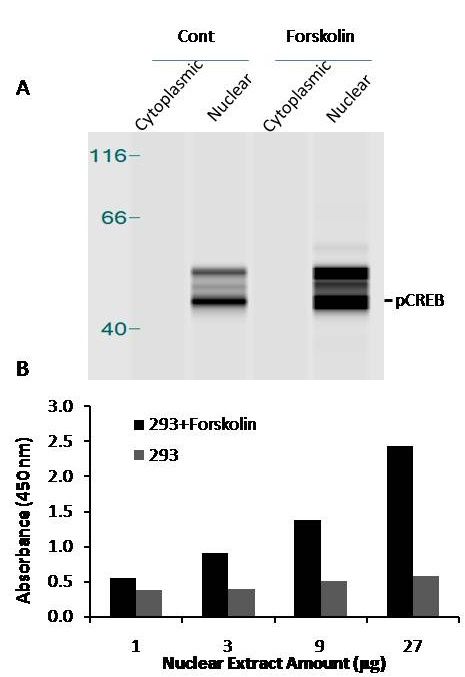
Figure 2
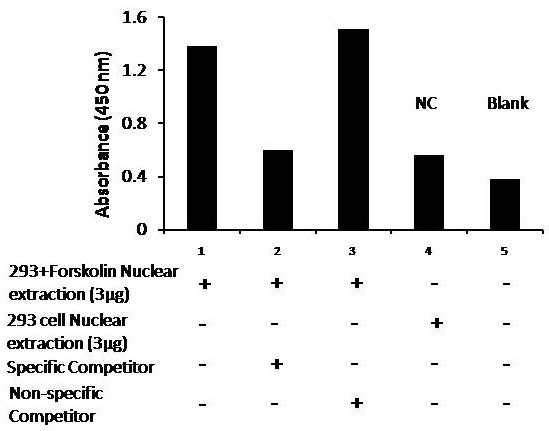
Transcription factor activity assay of pCREB from nuclear extracts of HEK293 cells or 293 cells treated with Forskolin (10üM) for 4 hr with the specific competitor or non-specific competitor. The result shows specific binding of pCREB to the CREB binding site.
Storage/Stability
Upon receipt, the positive control should be removed and stored at -20° or -80°C. The remainder of the kit can be stored for up to 6 months at 2-8°C from the date of shipment. Opened Microplate Wells or reagents may be stored for up to 1 month at 2° to 8°C. Return unused wells to the pouch containing desiccant pack, reseal along entire edge.
Note: The kit can be used within one year if the whole kit is stored at -20°C upon receipt. Avoid repeated freeze-thaw cycles.
