Introduction
RayBio® Phospho-TIE-2 ELISA kit is a very rapid, convenient and sensitive assay kit that can monitor the activation or function of important biological pathways in cell lysates. By determining phospho-TIE-2 in your experimental model system, you can verify pathway activation in your cell lysates. You can simultaneously measure numerous different cell lysates without spending excess time and effort in performing a Western Blot analysis.
This Sandwich ELISA kit is an in vitro enzyme-linked immunosorbent assay for the measurement of human phospho-TIE-2. An anti-TIE-2 antibody has been coated onto a 96-well plate. Samples are pipetted into the wells and phosphorylated and unphosphorylated TIE-2 present in a sample is bound to the wells by the immobilized antibody. The wells are washed and biotinylated anti-phosphotyrosine antibody is used to detect only tyrosine-phosphorylated protein. After washing away unbound antibody, HRP-conjugated streptavidin is pipetted to the wells. The wells are again washed, a TMB substrate solution is added to the wells and color develops in proportion to the amount of phospho-TIE-2 bound. The Stop Solution changes the color from blue to yellow, and the intensity of the color is measured at 450 nm.
Product Features
- Rapidly measure phosphorylated protein in lysates
- Screen numerous different cell lysates without performing a Western Blot analysis
- Minimal hands-on time, convenient, and non-radioactive material
Application Notes
Kit Components
- Pre-Coated 96-well Strip Microplate
- Wash Buffer
- Biotinylated Anti-Phosphotyrosine Antibody
- Stop Solution
- Assay Diluent(s)
- Positive Control Sample
- Lysis Buffer
- Streptavidin-Conjugated HRP
- TMB One-Step Substrate
Other Materials Required
- Distilled or deionized water
- 100 ml and 1 liter graduated cylinders
- Tubes to prepare sample dilutions
- Protease and Phosphatase inhibitors
- Precision pipettes to deliver 2 µl to 1 ml volumes
- Adjustable 1-25 ml pipettes for reagent preparation
- Benchtop rocker or shaker
- Microplate reader capable of measuring absorbance at 450 nm
Protocol Outline
- Prepare all reagents and samples as instructed in the manual.
- Add 100 µl of sample or positive control to each well.
- Incubate 2.5 h at RT or O/N at 4 °C.
- Add 100 µl of prepared primary antibody to each well.
- Incubate 1 h at RT.
- Add 100 µl of prepared 1X HRP-Streptavidin to each well.
- Incubate 1 h at RT.
- Add 100 µl of TMB One-Step Substrate Reagent to each well.
- Incubate 30 min at RT.
- Add 50 µl of Stop Solution to each well.
- Read at 450 nm immediately.
Typical Data
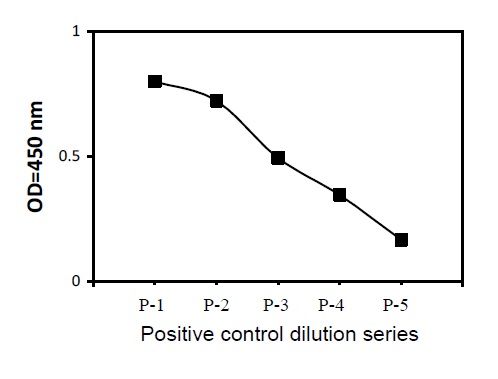
Positive Control
K562 cells were treated with Pervanadate at 37°C for 10 min. Solubilize cells at 4 x 10
7 cells/ml in lysis buffer. Serial dilutions of lysates were analyzed in this ELISA. Please see step 3 of Part VI Reagent Preparation for detail.
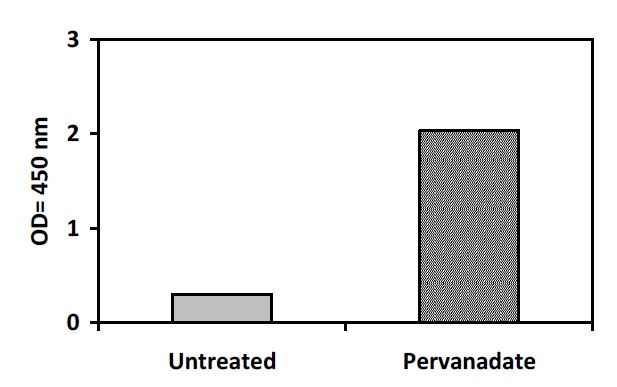
Pervanadate Stimulation of HUVEC Cell Line
HUVEC cells were treated or untreated with Pervanadate for 10 min at 37°C. Cell lysates were analyzed using this phosphoELISA:
Storage/Stability
Upon receipt, the kit should be stored at -20 °C. Please use within 6 months from the date of shipment. After initial use, Wash Buffer Concentrate (Item B), Assay Diluent (Item E), TMB One-Step Substrate Reagent (Item H), HRP-Streptavidin (Item G), Stop Solution (Item I) and Cell Lysate Buffer (Item J) should be stored at 4 °C to avoid repeated freeze-thaw cycles. Return unused wells to the pouch containing desiccant pack, reseal along entire edge and store at -20 °C. Reconstituted Positive Control (Item K) should be stored at -70 °C.