RayBio® Human PILR-alpha ELISA Kit for Serum, Plasma, and Cell Culture Supernatants.
Lead time: Typically ships within 1-2 business days. No Friday shipments.
RayBio® Human PILR-alpha ELISA Kit for Serum, Plasma, and Cell Culture Supernatants.
Lead time: Typically ships within 1-2 business days. No Friday shipments.
| Size | 1 Plate Kit, 2 Plate Kit, 5 Plate Kit |
| Estimated Lead Time | 1-2 business days |
| Species | Human |
| Sensitivity | 5.5 pg/ml Need more sensitivity? Check out the new NexaTag® kit for this target. Still not enough? Then your answer is our Ultrasensitive Biomarker Testing Service powered by Simoa™ technology. |
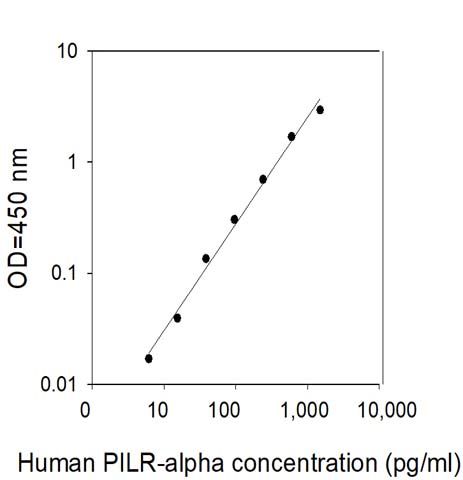
| Detection Range | 5.5 pg/ml -1500pg/ml |
| Specificity | This ELISA kit shows no cross-reactivity with the following cytokines tested: human ANGPTL7, CD36, CLEC9a, CL-P1, Dectin-2, DLL4, DSCAM, EDIL3, ENPP-7, Enteropeptidase, FCRL3, FCRLB, FGF-3, FLRT1, FLRT2, GBA3, GDF-11, Glycoprotein V, Granzyme A, IGSF4B, IL-28 R alpha, Kynureninase, LAMA4, LRRC4, LRRTM3, NG2, NQO-1, PCSK2, Plexin A4, POGLUT1, PRELP, Smad4, SOX15, SOX7, SOX9, Syntaxin 6, TROP-2, TSLP R, UNC5H4. |
| Compatible Sample Types | Cell Culture Supernatants, Plasma, Serum |
| Recommended Dilution (Serum/Plasma) | 20 fold |
| Accession Number | Q9UKJ1 |
| Gene Id | 29992 |
| Gene Symbols | PILRA |
| Protein Name / Synonyms | Paired immunoglobulin-like type 2 receptor alpha (Cell surface receptor FDF03) (Inhibitory receptor PILR-alpha) |
| Quantitative/Semi-Quantitative | Quantitative |
| Solid Support | 96-well Microplate |
| Design Principle | Sandwich-based |
| Method Of Detection | Colorimetric |
| Shipping Type | Blue ice |
| Storage | -20°C |
We manufacture our ELISAs in-house, so we can build a custom version for your study.
Feasibility varies by target and modification, and we’ll tell you upfront what’s achievable.
Your cart is empty.
Human PILR-alpha ELISA Kit
Measured human plasma at 20-fold & 50-fold dilutions and obtained values in range. Measured human urine at 2-fold & 5-fold dilution and was able to obtain values in range at both dilutions.
Review by Anonymous, from University of Michigan, on Nov 3, 2023
RayBio® Human PILR-alpha ELISA Kit for Serum, Plasma, and Cell Culture Supernatants.
Lead time: Typically ships within 1-2 business days. No Friday shipments.
Human PILR-alpha ELISA Kit
