Introduction
Hepatocyte growth factor regulates cell growth, cell motility, and morphogenesis by activating a tyrosine kinase signaling cascade after binding to the proto-oncogenic c-Met receptor. Hepatocyte growth factor is secreted by mesenchymal cells and acts as a multi-functional cytokine on cells of mainly epithelial origin. Its ability to stimulate mitogenesis, cell motility, and matrix invasion gives it a central role in angiogenesis, tumorogenesis, and tissue regeneration. It is secreted as a single inactive polypeptide and is cleaved by serine proteases into a 69-kDa alpha-chain and 34-kDa beta-chain. A disulfide bond between the alpha and beta chains produces the active, heterodimeric molecule. The protein belongs to the plasminogen subfamily of S1 peptidases but has no detectable protease activity. Alternative splicing of this gene produces multiple transcript variants encoding different isoforms. [provided by RefSeq].
Specificity
Other Names
HGF; HPTA; Hepatocyte growth factor; Hepatopoietin-A; Scatter factor; Hepatocyte growth factor alpha chain; Hepatocyte growth factor beta chain
NCBI Accession #
NP_000592.3;NP_001010931.1;NP_001010932.1;NP_001010933.1;NP_001010934.1
Other Accession #
NP_000592.3
Format
Type
Mouse Monoclonal Antibody (Mab)
Calculated Molecular Weight (Da)
83134
Recommended Dilutions
WB: 1:100-250
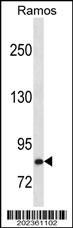 | HGF Antibody (Cat# 102-10293) western blot analysis in Ramos cell line lysates (35ug/lane).This demonstrates the HGF antibody detected the HGF protein (arrow). |
Antigen Source
HUMAN
Storage/Stability
2-8°C (short-term); -20°C (long-term)
Expiration:
12 months from the date of shipment when stored properly.