Background
This gene encodes the vasopressin receptor, type 2, also known as the V2 receptor, which belongs to the seven-transmembrane-domain G protein-coupled receptor (GPCR) superfamily, and couples to Gs thus stimulating adenylate cyclase. The subfamily that includes the V2 receptor, the V1a and V1b vasopressin receptors, the oxytocin receptor, and isotocin and mesotocin receptors in non-mammals, is well conserved, though several members signal via other G proteins. All bind similar cyclic nonapeptide hormones. The V2 receptor is expressed in the kidney tubule, predominantly in the distal convoluted tubule and collecting ducts, where its primary property is to respond to the pituitary hormone arginine vasopressin (AVP) by stimulating mechanisms that concentrate the urine and maintain water homeostasis in the organism. When the function of this gene is lost, the disease Nephrogenic Diabetes Insipidus (NDI) results. The V2 receptor is also expressed outside the kidney although its tissue localization is uncertain. When these 'extrarenal receptors' are stimulated by infusion of a V2 selective agonist (dDAVP), a variety of clotting factors are released into the bloodstream. The physiologic importance of this property is not known - its absence does not appear to be detrimental in NDI patients. The gene expression has also been described in fetal lung tissue and lung cancer associated with alternative splicing.
Dilutions
WB 1:500 - 1:2000
Format
Immunogen
Recombinant fusion protein containing a sequence corresponding to amino acids 232-371 of human AVPR2 (NP_000045.1).
Modification
Unmodified
Storage
-20°C
Images
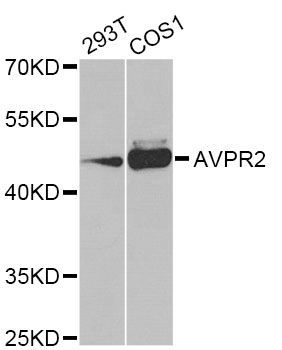
Western blot analysis of extracts of various cell lines, using AVPR2 Antibody (144-07879) at 1:1000 dilution.
Secondary antibody: HRP Goat Anti-Rabbit IgG (H+L) at 1:10000 dilution.
Lysates/proteins: 25ug per lane.
Blocking buffer: 3% nonfat dry milk in TBST.
Detection: ECL Basic Kit.
Exposure time: 90s.
Expiration:
12 months from the date of shipment when stored properly.