Introduction
Crystallins are separated into two classes: taxon-specific, or enzyme, and ubiquitous. The latter class constitutes the major proteins of vertebrate eye lens and maintains the transparency and refractive index of the lens. Since lens central fiber cells lose their nuclei during development, these crystallins are made and then retained throughout life, making them extremely stable proteins. Mammalian lens crystallins are divided into alpha, beta, and gamma families; beta and gamma crystallins are also considered as a superfamily. Alpha and beta families are further divided into acidic and basic groups. Seven protein regions exist in crystallins: four homologous motifs, a connecting peptide, and N- and C-terminal extensions. Alpha crystallins are composed of two gene products: alpha-A and alpha-B, for acidic and basic, respectively. Alpha crystallins can be induced by heat shock and are members of the small heat shock protein (sHSP also known as the HSP20) family. They act as molecular chaperones although they do not renature proteins and release them in the fashion of a true chaperone; instead they hold them in large soluble aggregates. Post-translational modifications decrease the ability to chaperone. These heterogeneous aggregates consist of 30-40 subunits; the alpha-A and alpha-B subunits have a 3:1 ratio, respectively. Two additional functions of alpha crystallins are an autokinase activity and participation in the intracellular architecture. Alpha-A and alpha-B gene products are differentially expressed; alpha-A is preferentially restricted to the lens and alpha-B is expressed widely in many tissues and organs. Elevated expression of alpha-B crystallin occurs in many neurological diseases; a missense mutation cosegregated in a family with a desmin-related myopathy.
Specificity
Predicted Reactivity
Rat, Bovine, Pig, Monkey, Rabbit
Other Names
CRYAB; CRYA2; Alpha-crystallin B chain; Alpha(B)-crystallin; Heat shock protein beta-5; Renal carcinoma antigen NY-REN-27; Rosenthal fiber component
NCBI Accession #
NP_001876.1
Other Accession #
P23928; P41316; Q7M2W6; P23927; Q60HG8; P02510; NP_001876.1
Format
Type
Peptide Affinity Purified Rabbit Polyclonal Antibody (Pab)
Calculated Molecular Weight (Da)
20159
Recommended Dilutions
WB: 1:1000; IHC: 1:10-50
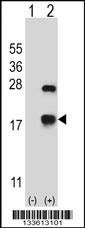 | Western blot analysis of CRYAB (arrow) using rabbit polyclonal CRYAB Antibody (Center) (Cat# 102-12105). 293 cell lysates (2 ug/lane) either nontransfected (Lane 1) or transiently transfected (Lane 2) with the CRYAB gene. |
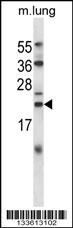 | CRYAB Antibody (Center) (Cat# 102-12105) western blot analysis in mouse lung tissue lysates (35ug/lane).This demonstrates the CRYAB antibody detected the CRYAB protein (arrow). |
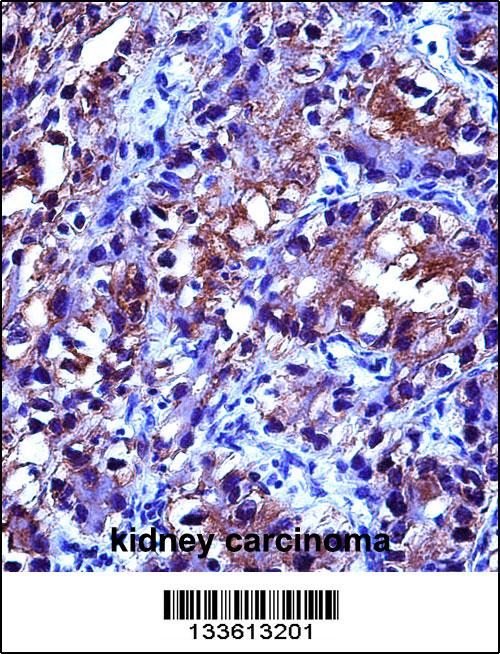 | CRYA Antibody (Center) (Cat# 102-12105)immunohistochemistry analysis in formalin fixed and paraffin embedded human kidney carcinoma followed by peroxidase conjugation of the secondary antibody and DAB staining.This data demonstrates the use of CRYA Antibody (Center) for immunohistochemistry. Clinical relevance has not been evaluated. |
Antigen Source
HUMAN
Storage/Stability
2-8°C (short-term); -20°C (long-term)
Expiration:
12 months from the date of shipment when stored properly.