Introduction
Receptor tyrosine kinases (RTKs) play a key role in the communication of cells with their microenvironment. These molecules are involved in the regulation of cell growth, differentiation and metabolism. In several cases the biochemical mechanism by which RTKs transduce signals across the membrane has been shown to be ligand induced receptor oligomerization and subsequent intracellular phosphorylation. This autophosphorylation leads to phosphorylation of cytosolic targets as well as association with other molecules, which are involved in pleiotropic effects of signal transduction. RTKs have a tripartite structure with extracellular, transmembrane and cytoplasmic regions. There are several subclasses of RTKs and TYRO10 belongs to a novel subclass. The deduced amino acid sequence of TYRO10 has a unique extracellular region encompassing a factor VIII-like domain, not previously described for RTKs.
Specificity
Other Names
DDR2; NTRKR3; TKT; TYRO10; Discoidin domain-containing receptor 2; CD167 antigen-like family member B; Discoidin domain-containing receptor tyrosine kinase 2; Neurotrophic tyrosine kinase, receptor-related 3; Receptor protein-tyrosine kinase TKT; Tyrosine-protein kinase TYRO10; CD_antigen=CD167b; Flags: Precursor
NCBI Accession #
NP_001014796.1;NP_006173.2
Format
Type
Purified Rabbit Polyclonal Antibody (Pab)
Calculated Molecular Weight (Da)
96736
Recommended Dilutions
WB: 1:1000
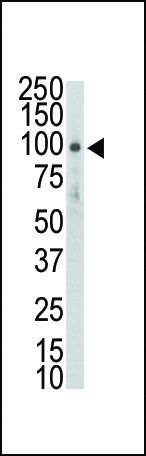 | Western blot analysis of anti-TRKA Pab (Cat#ap7686a) in mouse brain lysate. TRKA (arrow) was detected using purified Pab. Secondary HRP-anti-rabbit was used for signal visualization with chemiluminescence. |
Antigen Source
HUMAN
Storage/Stability
2-8°C (short-term); -20°C (long-term)
Expiration:
12 months from the date of shipment when stored properly.