Introduction
Potassium channels represent the most complex class of voltage-gated ion channels from both functional and structural standpoints. Their diverse functions include regulating neurotransmitter release, heart rate, insulin secretion, neuronal excitability, epithelial electrolyte transport, smooth muscle contraction, and cell volume. Four sequence-related potassium channel genes - shaker, shaw, shab, and shal - have been identified in Drosophila, and each has been shown to have human homolog(s). This gene encodes a member of the potassium channel, voltage-gated, shaker-related subfamily. This member contains six membrane-spanning domains with a shaker-type repeat in the fourth segment. It belongs to the A-type potassium current class, the members of which may be important in the regulation of the fast repolarizing phase of action potentials in heart and thus may influnce the duration of cardiac action potential. The coding region of this gene is intronless, and the gene is clustered with genes KCNA3 and KCNA10 on chromosome 1.
Specificity
Predicted Reactivity
Mouse, Rat, Bovine
Other Names
KCNA4; KCNA4L; Potassium voltage-gated channel subfamily A member 4; HPCN2; Voltage-gated K(+) channel HuKII; Voltage-gated potassium channel HBK4; Voltage-gated potassium channel HK1; Voltage-gated potassium channel subunit Kv1.4
NCBI Accession #
NP_002224.1
Other Accession #
P15385; Q61423; Q05037; NP_002224.1
Format
Type
Peptide Affinity Purified Rabbit Polyclonal Antibody (Pab)
Calculated Molecular Weight (Da)
73257
Recommended Dilutions
WB: 1:1000
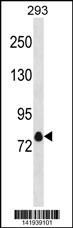 | KCNA4 Antibody (C-term) (Cat# 102-14503) western blot analysis in 293 cell line lysates (35ug/lane).This demonstrates the KCNA4 antibody detected the KCNA4 protein (arrow). |
Antigen Source
HUMAN
Storage/Stability
2-8°C (short-term); -20°C (long-term)
Expiration:
12 months from the date of shipment when stored properly.