Introduction
Macroautophagy is the major inducible pathway for the general turnover of cytoplasmic constituents in eukaryotic cells, it is also responsible for the degradation of active cytoplasmic enzymes and organelles during nutrient starvation. Macroautophagy involves the formation of double-membrane bound autophagosomes which enclose the cytoplasmic constituent targeted for degradation in a membrane bound structure, which then fuse with the lysosome (or vacuole) releasing a single-membrane bound autophagic bodies which are then degraded within the lysosome (or vacuole). MAP1A and MAP1B are microtubule-associated proteins which mediate the physical interactions between microtubules and components of the cytoskeleton. These proteins are involved in formation of autophagosomal vacuoles (autophagosomes). MAP1A and MAP1B each consist of a heavy chain subunit and multiple light chain subunits. MAP1LC3c is one of the light chain subunits and can associate with either MAP1A or MAP1B. The precursor molecule is cleaved by APG4B/ATG4B to form the cytosolic form, LC3-I. This is activated by APG7L/ATG7, transferred to ATG3 and conjugated to phospholipid to form the membrane-bound form, LC3-II.
Specificity
Other Names
MAP1LC3C; Microtubule-associated proteins 1A/1B light chain 3C; Autophagy-related protein LC3 C; Autophagy-related ubiquitin-like modifier LC3 C; MAP1 light chain 3-like protein 3; MAP1A/MAP1B light chain 3 C; Microtubule-associated protein 1 light chain 3 gamma
NCBI Accession #
NP_001004343.1
Format
Type
Peptide Affinity Purified Rabbit Polyclonal Antibody (Pab)
Calculated Molecular Weight (Da)
16852
Recommended Dilutions
WB: 1:1000
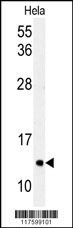 | Western blot analysis of APG8c (MAP1LC3C) Antibody (T48)(Cat# 102-13642) in Hela cell line lysates (35ug/lane). MAP1LC3C (arrow) was detected using the purified Pab. |
Antigen Source
HUMAN
Storage/Stability
2-8°C (short-term); -20°C (long-term)
Expiration:
12 months from the date of shipment when stored properly.