Introduction
The human AF9 gene is one of the most common fusion partner genes with the ALL1 gene at 11q23 (also called MLL), resulting in the t(9;11)(p22;q23). The AF9 gene is more than 100 kb, and 2 patient breakpoint cluster regions (BCRs) have been identified; BCR1 is within intron 4, previously called site A, whereas BCR2 or site B spans introns 7 and 8. Several different structural elements have been identified in AF9, including a colocalizing in vivo DNA topo II cleavage site and an in vitro DNase I hypersensitive (DNase 1 HS) site in intron 7 in BCR2. Reversibility experiments demonstrated a religation of the topo II cleavage sites. In addition, 2 scaffold associated regions (SARs) are located centromeric to the topo II and DNase I HS cleavage sites and border breakpoint regions in 2 leukemic cells lines: SAR1 is located in intron 4, whereas SAR2 encompasses parts of exons 5-7. The patient breakpoint regions of AF9 share the same structural elements as the MLL BCR. A DNA breakage and repair model for nonhomologous recombination between MLL and its partner genes, particularly AF9, has been proposed.
Specificity
Predicted Reactivity
Mouse
Other Names
MLLT3; AF9; YEATS3; Protein AF-9; ALL1-fused gene from chromosome 9 protein; Myeloid/lymphoid or mixed-lineage leukemia translocated to chromosome 3 protein; YEATS domain-containing protein 3
NCBI Accession #
NP_004520.2
Format
Type
Purified Rabbit Polyclonal Antibody (Pab)
Calculated Molecular Weight (Da)
63351
Recommended Dilutions
WB: 1:1000
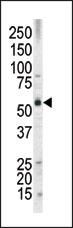 | The anti-MLLT3 Pab (Cat# 102-16671) is used in Western blot to detect MLLT3 in HL60 tissue lysate |
Antigen Source
HUMAN
Storage/Stability
2-8°C (short-term); -20°C (long-term)
Expiration:
12 months from the date of shipment when stored properly.