Introduction
Modification of target proteins by ubiquitin participates in a wide array of biological functions. Proteins destined for degradation or processing via the 26 S proteasome are coupled to multiple copies of ubiquitin. However, attachment of ubiquitin or ubiquitin-related molecules may also result in changes in subcellular distribution or modification of protein activity. An additional level of ubiquitin regulation, deubiquitination, is catalyzed by proteases called deubiquitinating enzymes, which fall into four distinct families. Ubiquitin C-terminal hydrolases, ubiquitin-specific processing proteases (USPs),1 OTU-domain ubiquitin-aldehyde-binding proteins, and Jab1/Pad1/MPN-domain-containing metallo-enzymes. Among these four families, USPs represent the most widespread and represented deubiquitinating enzymes across evolution. USPs tend to release ubiquitin from a conjugated protein. They display similar catalytic domains containing conserved Cys and His boxes but divergent N-terminal and occasionally C-terminal extensions, which are thought to function in substrate recognition, subcellular localization, and protein-protein interactions.
Specificity
Other Names
USP16; Ubiquitin carboxyl-terminal hydrolase 16; Deubiquitinating enzyme 16; Ubiquitin thioesterase 16; Ubiquitin-processing protease UBP-M; Ubiquitin-specific-processing protease 16
NCBI Accession #
NP_001001992.1;NP_001027582.1;NP_006438.1
Other Accession #
NP_006438
Format
Type
Purified Rabbit Polyclonal Antibody (Pab)
Calculated Molecular Weight (Da)
93570
Recommended Dilutions
WB: 1:1000
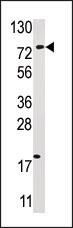 | Western blot analysis of anti-USP16 Pab (Cat# 102-14995) in HL60 cell line lysate (35ug/lane). USP16(arrow) was detected using the purified Pab. |
Antigen Source
HUMAN
Storage/Stability
2-8°C (short-term); -20°C (long-term)
Expiration:
12 months from the date of shipment when stored properly.