Introduction
ISG15 is secreted from monocytes in response to type I interferons and causes natural killer (NK)-cell proliferation and an augmentation of non-MCH (major histocompatibility complex)-restricted cytotoxicity. Synthesis is stimulated by IFN-alpha or IFN-beta or IFN-omega , but not IFN-gamma . ISG15 expression is also induced by overexpression of interferon regulatory factors that participate in transcriptional regulation of IFN genes, and by influenza B virus. ISG15 is secreted also by cell lines of monocyte, T-lymphocyte, B-lymphocyte, human fibroblasts, and epithelial origins. The induction of terminal differentiation in human melanoma cells is associated with alterations in ISG15 expression. Enhancement of NK cell proliferation, augmentation of non-major histocompatibility complex-restricted cytotoxicity, and induction of IFN-gamma from T cells identify ISG15 as a member of the cytokine cascade and suggest that it may be responsible for amplifying and directing some of the immunomodulatory effects of IFN-alpha or IFN-beta. ISG15 has has also been shown to function intracellularly as a ubiquitin homolog.
Other Information
NCBI Accession #
NP_005092.1
Antigen Type
Synthetic Peptide
Format
Purified polyclonal antibody supplied in PBS with 0.09% (W/V) sodium azide. This antibody is prepared by Saturated Ammonium Sulfate (SAS) precipitation followed by dialysis against PBS.
Calculated Molecular Weight (Da)
17888
Images
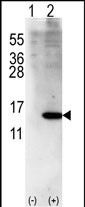
WB (1:1000)
Western blot analysis of ISG15(arrow) using rabbit polyclonal ISG15 Antibody (Center R87) (Cat.#102-20865). 293 cell lysates (2 ug/lane) either nontransfected (Lane 1) or transiently transfected with ISG15 gene (Lane 2) (Origene Technologies).
Storage/Stability
2-8°C (short-term); -20°C (long-term)
Expiration:
12 months from the date of shipment when stored properly.