Introduction
Histone methyltransferases (HMTases) selectively methylate evolutionarily conserved arginine or lysine residues, primarily in the N-terminal tails of histones H3 and H4. Signal transduction pathways affecting the N-terminal tails of histones lead to a number of post-translational modifications including acetylation, phosphorylation, poly(ADP-ribosylation), ubiquitination and methylation. These modifications play critical roles in regulating chromatin structure and gene expression. Set7/9 is a histone specific HMTase that methylates histone H3 lysine 4. Set7/9 transfers methyl groups to lysine 4 of histone H3 in complex with S-adenosyl-L-methionine. In yeast, H4-K20 methylation does not have any apparent role in the regulation of gene expression or heterochromatin function; rather it appears to play a role in DNA damage response. Loss of Set9 activity or mutation of H4-K20 markedly impairs yeast cell survival after genotoxic challenge and compromises the ability of cells to maintain checkpoint mediated cell cycle arrest. Genetic experiments link Set9 to Crb2, a homolog of the mammalian checkpoint protein 53BP1, and the enzyme is required for Crb2 localization to sites of DNA damage.
Other Information
NCBI Accession #
NP_085151.1
Antigen Type
Synthetic Peptide
Format
Purified polyclonal antibody supplied in PBS with 0.09% (W/V) sodium azide. This antibody is prepared by Saturated Ammonium Sulfate (SAS) precipitation followed by dialysis against PBS.
Calculated Molecular Weight (Da)
40721
Images
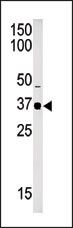
WB (1:1000)
Western blot analysis of anti-SET7 Pab(Cat. #102-20980) in mouse brain tissue lysate (35ug/lane). SET7(arrow) was detected using the purified Pab.
Storage/Stability
2-8°C (short-term); -20°C (long-term)
Expiration:
12 months from the date of shipment when stored properly.