Product Type
Expression Medium
Culture Type
Suspension Cell Culture
Osmolality
280-300 mOsm/kg
Additives
GlutaMAX, Sodium Pyruvate, Sodium Bicarbonate, Dextrose, Pyridoxine HCl
Exclusions
No HEPES, No Phenol Red, No Hypoxanthine, No Thymidine, No Insulin, No Vitamin A, No 2-Mercaptoethanol
Introduction
RayBio® HEK293 Suspension Expression Medium is a chemically defined, serum-free medium formulated to support high-density suspension culture and high-efficiency transient transfection of HEK293 cells in suspension. This complete medium is ready to use and ideal for protein and viral vector expression in various HEK293 cell lines but it is not recommended for adherent HEK293 cell lines.
Features
- Chemically defined, serum-free formulation
- Protein-free formulation (no serum, insulin, or growth factors)
- Animal-origin free (ADCF)
- Free of hydrolysates and exogenous proteins
- Suitable for high-density suspension culture of HEK293 cells
- Contains L-glutamine (6 g/L)
- Supports high-level recombinant protein and viral vector expression
Typical Data
RayBio® HEK293 Suspension Expression Medium demonstrated superior performance in viable cell density and cell viability (Figure 1) compared to Competitor 1 and Competitor 2.
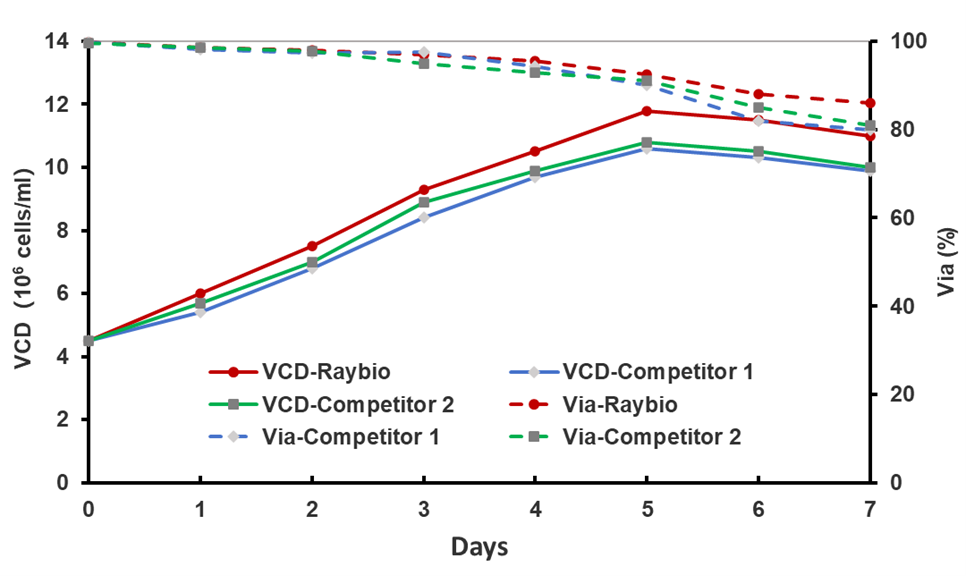
Viable Cell Density (VCD, 10⁶ cells/mL) and Viability (Via, %) of cultures grown in different media.
VCD: All samples showed a significant increase in cell density over the first four days, after which growth plateaued. Raybio medium reached its peak VCD on Day 5 before a slight decline. In contrast, Competitor 1 and Competitor 2 showed lower VCD than those of Raybio product.
Viability: Cell viability remained near 100% for all samples during the first four days. Raybio medium maintained the highest viability through Day 5, despite a slight decrease. Competitor 1 and Competitor 2 also showed reduced viability after Day 4, remaining consistently lower than Raybio medium.
Storage/Stability
Upon receipt, store at 2-8 °C. RayBio® HEK293 Suspension Expression Medium is sensitive to light. Use and store the medium protected from light. The shelf life is12 months. Do not freeze. Use within 3 months after opening; supplement with 4 mM glutamine if used beyond 3 months.
Frequently asked questions (FAQs)
◎ What Is VCD in 293 Cell Culture?
In HEK293 cell culture, VCD typically stands for Viable Cell Density, measured in cells/mL. It refers to the number of living cells per unit volume of culture medium and is a key indicator for evaluating cell growth and culture performance.
- Significance of VCD
- Assessing Cell Proliferation: VCD reflects the growth rate and quantity of cells over time, helping researchers understand the proliferation status.
- Determining Passage Timing: When VCD reaches a certain threshold (e.g., 80–90% confluency), it indicates that cells need to be passaged to avoid overgrowth, nutrient depletion, and accumulation of metabolic waste.
- Optimizing Culture Conditions: Monitoring VCD allows adjustment of parameters such as media formulation, seeding density, and culture temperature to create optimal growth conditions.
- Estimating Yield: In biopharmaceutical applications, VCD helps estimate production output, providing a basis for downstream processing or experimental planning.
- Methods for Measuring VCD
- Microscopic Cell Counting: Using a hemocytometer and trypan blue exclusion to manually count viable cells under a microscope.
- Automated Cell Counters: Instruments using impedance, optical imaging, or fluorescent dyes to quickly and accurately determine cell density and viability.
- Colorimetric Assays: Indirect measurement through metabolic activity indicators like MTT or Alamar Blue, which correlate with viable cell numbers.
- Key Considerations
- Ensure Even Cell Suspension: Mix cell suspensions thoroughly before sampling to avoid inaccurate counts caused by cell settling.
- Distinguish Live and Dead Cells: Use viability dyes (e.g., trypan blue) to exclude dead cells from VCD measurements.
- Choose the Right Method: Select a suitable measurement technique based on your experimental goals and available equipment.
To sum up, VCD is a critical parameter in 293 cell culture. Real-time monitoring of VCD helps track cell growth dynamics, optimize culture conditions, and ensure reliable and reproducible experimental outcomes.
◎ What Is Viral Titer, Antibody Titer, and Cell Titer?
In 293 cell culture, the term "titer" generally refers to the concentration or functional activity of a specific substance (such as virus, antibody, or cells) under defined conditions. Below are detailed explanations of each type:
- Viral Titer: In virology-related 293 cell cultures, titer usually refers to the concentration or infectivity of a virus. It is commonly measured using plaque-forming units (PFU) or 50% tissue culture infectious dose (TCID50), both of which reflect the virus’s ability to infect and kill host cells under specific conditions.
- Antibody Titer: In immunology experiments, titer refers to the concentration or potency of an antibody, typically determined via serum dilution assays. Antibody titer indicates the highest dilution at which antibodies in the serum still show detectable binding to a specific antigen.
- Cell Titer: In some cases, titer may refer to cell concentration or viability. For example, in transfection experiments, transfection titer may describe the ratio of transfection reagent to cells, which can significantly impact transfection efficiency.
◎ Common Issues in Cell Culture and Their Troubleshooting Strategies
- Slow or No Cell Growth
- Culture Medium Composition Issues: Ensure the medium is fully dissolved, free of precipitates, and supplemented with necessary growth factors or L-glutamine.
- Abnormal pH: Verify that the pH of the medium is within the optimal range (typically 7.0–7.4).
- Contamination: Check for bacterial, fungal, or mycoplasma contamination in the medium or culture environment.
- Inappropriate Cell Seeding Density: Adjust the initial cell density to avoid overgrowth or under-seeding.
- Culture Conditions: Confirm that the incubator settings (temperature, CO2 level, humidity) are correct.
- Abnormal Cell Morphology
- Poor Medium Quality: Ensure the medium is not expired and has been stored properly.
- Nutrient Deficiency: Supplement with additional amino acids, vitamins, or growth factors if necessary.
- Toxic Contaminants: Check for residual antibiotics, disinfectants, or other toxic substances.
- Color Change in Culture Medium
- pH Shifts: Medium color changes often reflect pH changes—verify that pH remains within the normal range.
- Oxidation: Certain components may oxidize during storage or use, causing color changes.
- Contamination: Microbial contamination may also alter the color of the medium.
- Precipitate Formation
- Incomplete Dissolution: Ensure all components are completely dissolved, especially after cold storage.
- Component Incompatibility: Some ingredients may be incompatible under certain conditions, leading to precipitation.
- Improper Storage Conditions: Confirm storage temperatures meet the manufacturer’s guidelines—avoid excessive heat or cold.
- Cell Death or Apoptosis
- Unsuitable Culture Conditions: Recheck temperature, CO2 concentration, and humidity settings.
- Infrequent Medium Replacement: Delayed medium changes can result in nutrient depletion and waste accumulation.
- Mechanical Damage: Handle cells gently during passaging or pipetting to avoid physical damage.
- Toxic Residues: Check for residual antibiotics, disinfectants, or harmful chemicals.
- Foaming Issues
- Improper Handling: Avoid vigorous shaking or rapid pipetting, which can introduce foam.
- Medium Composition: Some media formulations are prone to foaming; consider switching formulations or adding anti-foaming agents.
- Mycoplasma Contamination
- Prevention: Use aseptic techniques and regularly test media and cell lines for contamination.
- Response: If contamination is detected, discard affected cultures, disinfect the environment, and treat with mycoplasma removal agents if necessary.
- Batch-to-Batch Variation
- Supplier Differences: Media from different lots may vary; perform validation tests before switching lots.
- Storage & Handling: Follow the supplier’s storage and handling recommendations to reduce variability.
- Other Issues
- Medium Clumping: Moisture exposure may cause clumping; avoid storing medium in high-humidity environments.
- Medium Spoilage: Discontinue use immediately if the medium appears cloudy, has an unusual odor, or shows other signs of degradation.