Recombinant human Apolipoprotein E, derived from the transfected human HEK293 cells.
Loading...
Loading...
Loading...
Loading...
Recombinant Human Apolipoprotein E (Apo E)
| Size | 10 µg, 50 µg |
| Estimated Lead Time | 1-2 business days |
| Species | Human |
| Accession Number | P02649 |
| Gene Id | 348 |
| Gene Symbols | APOE |
| Protein Name / Synonyms | Apolipoprotein E (Apo-E), Apolipoprotein E, APO-E, Alzheimer Disease 2 (APOE*E4-Associated, Late Onset), Apolipoprotein E3, LDLCQ5, ApoE4, LPG, AD2 |
| Expressed Region | Lys19-His317 |
| Expression System | HEK293 cells |
| Tag | N-terminal histidine tag |
| Purity | >95% |
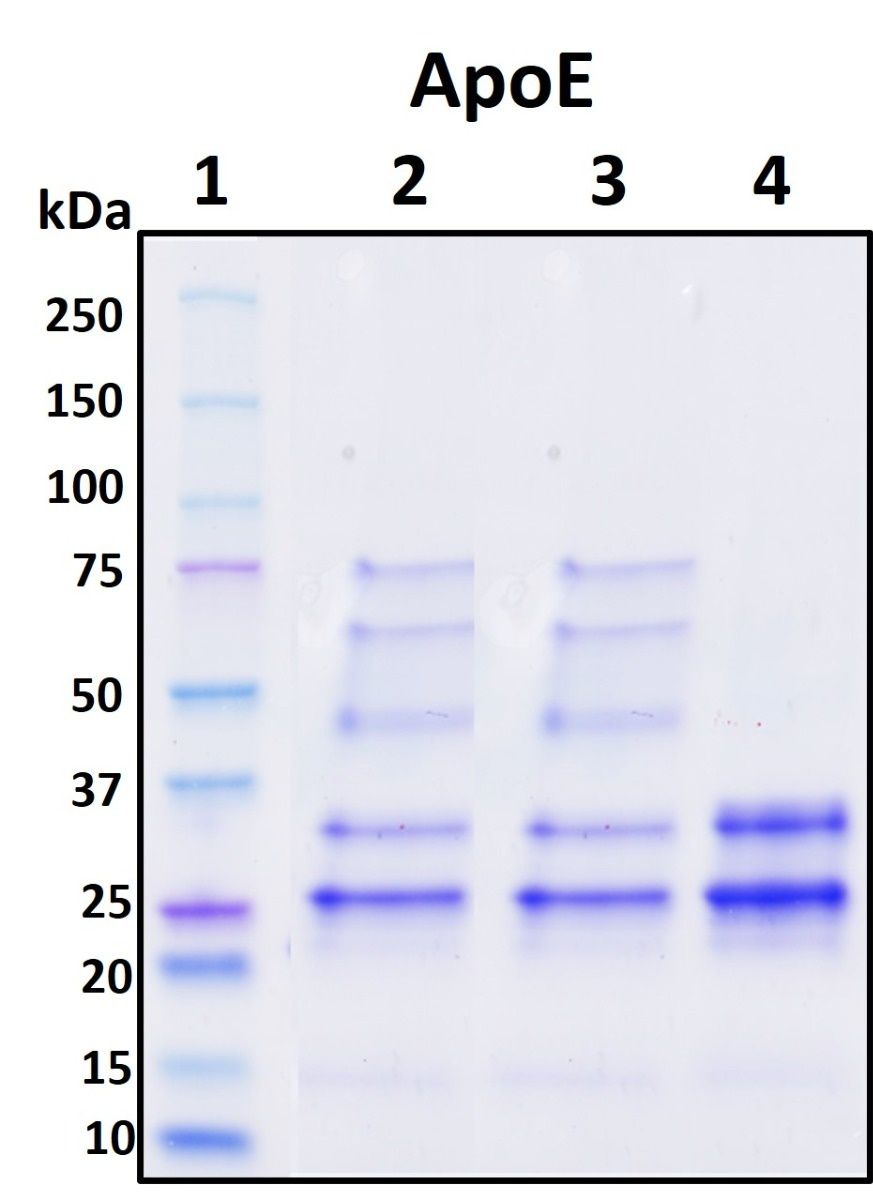
| Purity Determined By | SDS-PAGE under reducing conditions and visualized by Coomassie blue staining |
| Molecular Weight (kDa) | Recombinant protein has a calculated molecular weight of about 37 kDa. Due to the abundant glycosylation, the protein migrates as approximately 25-75 kDa protein bands in SDS-PAGE under DTT, beta-mercaptoethanol reducing conditions. See deglycosylation analysis image below. |
| Format | Lyophilized powder |
| Formulation | Lyophilized from a 0.2 µm filtered solution in PBS |
| Concentration (lot specific) | Determined by Pierce BCA protein assay kit |
| Preservative | None |
| Reconstitution | Briefly spin the vial and bring the contents to the bottom prior to opening. It is recommended to reconstitute at 0.5 - 1 mg/mL with sterile deionized water. |
| Endotoxin Level | Not determined |
| Research Area | Cardiovascular Disease, Inflammation, Glycolysis & Lipid Metabolism |
| Shipping Type | Ambient temperature |
| Storage | -20°C |
Apolipoprotein E (ApoE) is a 34-kDa glycoprotein primarily synthesized in the liver, but also produced in other tissues such as the brain, kidneys, and spleen. It plays a crucial role in lipid metabolism by serving as a ligand for low-density lipoprotein receptors, facilitating the clearance of chylomicron remnants and very low-density lipoproteins from the bloodstream. In the central nervous system, ApoE is predominantly produced by astrocytes and is involved in neuronal growth and repair processes. Genetic polymorphisms in the APOE gene are associated with varying risks for cardiovascular diseases and neurodegenerative disorders, including Alzheimer's disease.
Reference: https://pubmed.ncbi.nlm.nih.gov/3283935/
Your cart is empty.
Recombinant Human Apolipoprotein E (Apo E)
