Recombinant human Biotinidase protein with His-tag derived from E.coli
Loading...
Loading...
Loading...
Loading...
Recombinant Human Biotinidase Protein, Antigen Grade
| Size | 10 µg, 50 µg, 100 µg |
| Estimated Lead Time | 1-2 business days |
| Species | Human |
| Accession Number | P43251 |
| Gene Symbols | BTD |
| Protein Name / Synonyms | Biotinidase, EC 3.5.1.12, Biotinase, EC 3.5.1. |
| Expressed Region | Ala42-Asp543 |
| Expression System | E. coli |
| Tag | N-terminal His-tag |
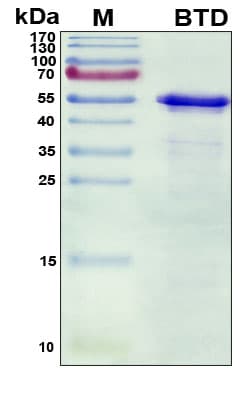
| Purity | >90% |
| Purity Determined By | SDS-PAGE under reducing conditions and visualized by Coomassie blue staining |
| Molecular Weight (kDa) | 57 kDa |
| Format | Liquid |
| Formulation | Supplied as a 0.2 µm filtered solution in 20 mM Tris-HCl (pH 7.4), 10 mM EDTA, 8 M urea. |
| Concentration (lot specific) | Refer to the label on the vial for the specific concentration, determined by Bio-Rad Bradford protein dye reagent concentrate. |
| Shipping Type | Blue ice |
| Storage | -20°C |
"Antigen Grade" is not a formally regulated industry standard, but it is commonly used to indicate that a protein is intended for antigen-based applications rather than functional assays.
Antigen Grade proteins are recombinant proteins purified under denaturing conditions (e.g., in urea) and may not retain their native conformation or biological activity. These proteins are suitable for antigen-based applications such as antibody generation, ELISA plate coating, Western blotting, and other immunological assays, but are not recommended for functional or activity assays.
Many bacterial proteins expressed as inclusion bodies are purified in 6–8 M urea. Although they can often be refolded, proteins sold in urea are generally not guaranteed to be correctly refolded or biologically active. "Antigen Grade" proteins are suitable for immunological applications but may not be appropriate for assays requiring native protein function.
Your cart is empty.
Recombinant Human Biotinidase Protein, Antigen Grade