Recombinant human occludin/BLCPMG protein derived from E.coli
Loading...
Loading...
Loading...
Loading...
Recombinant Human Occludin (BLCPMG) Protein
| Size | 10 µg, 50 µg, 100 µg, 250 µg |
| Estimated Lead Time | 1-2 business days |
| Species | Human |
| Accession Number | Q16625 |
| Gene Id | 100506658 |
| Gene Symbols | OCLN |
| Protein Name / Synonyms | Occludin, BLCPMG, Tight Junction Protein Occludin TM4 Minus, Phosphatase 1, Regulatory Subunit 115, Tight Junction Protein Occludin, Regulatory Subunit 115, Phosphatase 1, PPP1R115 |
| Expressed Region | Lys266-Thr522 |
| Expression System | E. coli |
| Tag | N-terminal histidine tag |
| Purity | >90% |
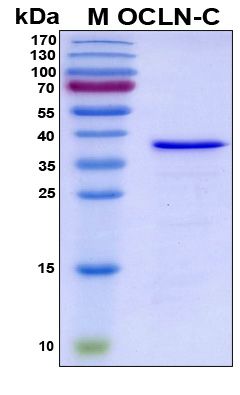
| Purity Determined By | SDS-PAGE under reducing conditions and visualized by Coomassie blue staining |
| Molecular Weight (kDa) | 37 kDa |
| Format | Lyophilized powder |
| Formulation | Lyophilized from a 0.45 µm filtered solution in PBS (pH 7.4). |
| Concentration (lot specific) | Determined by Bio-Rad protein assay dye reagent concentrate. |
| Preservative | None |
| Reconstitution | Briefly spin the vial and bring the contents to the bottom prior to opening. It is recommended to reconstitute at 0.5~1.0 mg/mL with sterile deionized water. |
| Endotoxin Level | Not determined |
| Shipping Type | Ambient temperature |
| Storage | -20°C |
Occludin is an integral membrane protein predominantly expressed in epithelial and endothelial cells, where it plays a critical role in the formation and maintenance of tight junctions. These tight junctions are essential for regulating paracellular permeability, thereby controlling the selective passage of ions and molecules between cells. Occludin's structure comprises four transmembrane domains, with both N-terminal and C-terminal regions located intracellularly. The C-terminal domain interacts with various cytoplasmic proteins, such as zonula occludens-1 (ZO-1), linking occludin to the actin cytoskeleton and influencing cell signaling pathways. Alterations in occludin expression or function have been associated with disrupted barrier integrity, contributing to various pathological conditions, including inflammation and tumor progression.
Reference: https://pubmed.ncbi.nlm.nih.gov/15820558/
Your cart is empty.
Recombinant Human Occludin (BLCPMG) Protein