Introduction
Many different human endogenous retrovirus (HERV) families are expressed in normal placental tissue at high levels, suggesting that HERVs are functionally important in reproduction. This gene is part of an HERV provirus on chromosome 7 that has inactivating mutations in the gag and pol genes. This gene is the envelope glycoprotein gene which appears to have been selectively preserved. The gene's protein product is expressed in the placental syncytiotrophoblast and is involved in fusion of the cytotrophoblast cells to form the syncytial layer of the placenta. The protein has the characteristics of a typical retroviral envelope protein, including a furin cleavage site that separates the surface (SU) and transmembrane (TM) proteins which form a heterodimer. Alternatively spliced transcript variants encoding the same protein have been found for this gene.
Specificity
Other Names
ERVW-1; ERVWE1; HERV-W_7q21.2 provirus ancestral Env polyprotein; Endogenous retrovirus group W member 1; Env-W; Envelope polyprotein gPr73; Enverin; HERV-7q Envelope protein; HERV-W envelope protein; Syncytin; Syncytin-1; Surface protein; gp50; Transmembrane protein; gp24
NCBI Accession #
NP_001124397.1;NP_055405.3
Other Accession #
NP_055405.3; NP_001124397.1
Format
Type
Peptide Affinity Purified Rabbit Polyclonal Antibody (Pab)
Calculated Molecular Weight (Da)
59866
Recommended Dilutions
WB: 1:1000
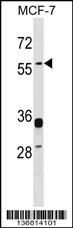 | ERVWE1 Antibody (C-term) (Cat# 102-13245) western blot analysis in MCF-7 cell line lysates (35ug/lane).This demonstrates the ERVWE1 antibody detected the ERVWE1 protein (arrow). |
Antigen Source
HUMAN
Storage/Stability
2-8°C (short-term); -20°C (long-term)
Expiration:
12 months from the date of shipment when stored properly.