Introduction
Hydrolase that can remove conjugated ubiquitin from proteins and therefore plays an important regulatory role at the level of protein turnover by preventing degradation. Converts both 'Lys-48' an 'Lys-63'-linked ubiquitin chains. Catalytic activity is enhanced in the M phase. Involved in cell proliferation. Required to enter into S phase in response to serum stimulation. May regulate T-cell anergy mediated by RNF128 via the formation of a complex containing RNF128 and OTUB1. Probably regulates the stability of STAM2 and RASGRF1. Regulates endosomal ubiquitin dynamics, cargo sorting, membrane traffic at early endosomes, and maintenance of ESCRT-0 stability. The level of protein ubiquitination on endosomes is essential for maintaining the morphology of the organelle. Deubiquitinates EPS15 and controles tyrosine kinase stability. Removes conjugated ubiquitin from EGFR thus regulating EGFR degradation and downstream MAPK signaling. Involved in acrosome biogenesis through interaction with the spermatid ESCRT-0 complex and microtubules.
Specificity
Predicted Reactivity
Mouse
Other Names
USP8; KIAA0055; UBPY; Ubiquitin carboxyl-terminal hydrolase 8; Deubiquitinating enzyme 8; Ubiquitin isopeptidase Y; Ubiquitin thioesterase 8; Ubiquitin-specific-processing protease 8
NCBI Accession #
NP_001122082.1;NP_001122083.1;NP_005145.3
Other Accession #
Q80U87; NP_001122082.1
Format
Type
Mouse Monoclonal Antibody (Mab)
Calculated Molecular Weight (Da)
127523
Recommended Dilutions
WB: 1:500-4000
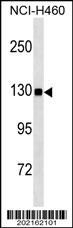 | USP8 Antibody (C1072) (Cat# 102-10280) western blot analysis in NCI-H460 cell line lysates (35ug/lane).This demonstrates the USP8 antibody detected the USP8 protein (arrow). |
Antigen Source
HUMAN
Storage/Stability
2-8°C (short-term); -20°C (long-term)
Expiration:
12 months from the date of shipment when stored properly.