U937 exosomes were captured by bead-based immunoprecipitation, stained with dye-conjugated antibodies against specific surface markers, and analyzed via flow cytometry.
Purified Exosomes from U937 Cells
This product contains purified exosomes isolated from U937 cells, an immortalized human monocyte cell line.
U937 cells, an immortalized human monocyte cell line
Introduction
Exosomes are nanosized extracellular vesicles (30 - 150 nm) released by virtually all cell types and recognized as critical mediators of intercellular communication. They transport functional biomolecules - including proteins, mRNA, miRNA, and lipids - to target cells, influencing pathways involved in tissue regeneration, immune regulation, inflammation, and disease progression. Owing to their natural biocompatibility, stability, and specificity, exosomes have become an important focus in biomarker discovery, drug delivery, and therapeutic development.
Components and Preparation
This product contains purified exosomes isolated from U937 cells, an immortalized human monocyte cell line. Exosomes were prepared from U937 cell culture supernatant by sequential centrifugation, polymer precipitation, and size-exclusion chromatography (SEC). Purified exosomes are formulated and stored in 0.05 µm (50 nm)-filtered PBS containing 5% trehalose and protease inhibitor cocktail.
Characterization
Exosomes were characterized by flow cytometry to confirm expression of universal exosome markers CD9, CD63, and CD81, as well as additional cell-specific markers. For U937-derived exosomes specifically, CD9, CD63, CD81, and CD14 were analyzed. As shown in Figure 1, exosomes showed strong expression of CD9, CD63, and CD81.
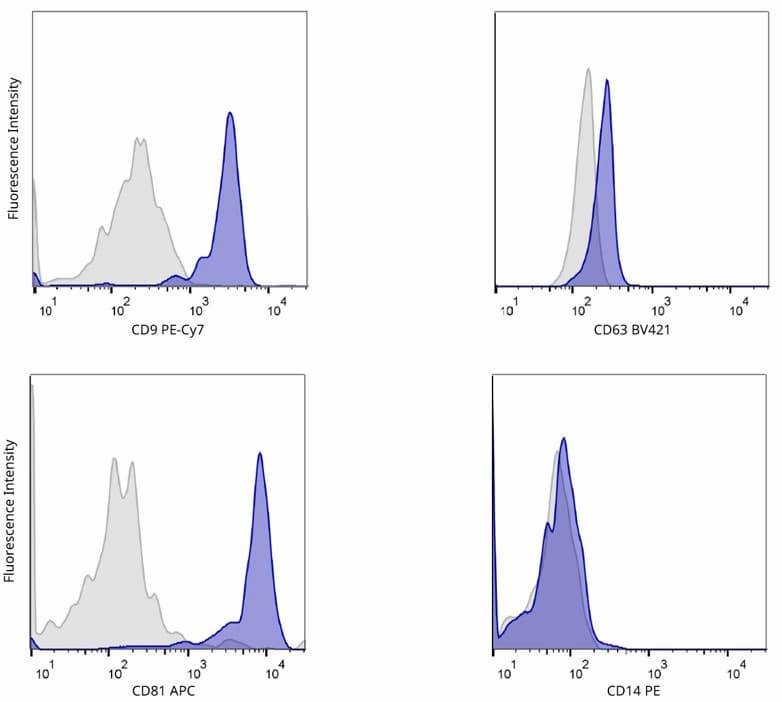
Figure 1. U937 exosomes were captured by bead-based immunoprecipitation, stained with dye-conjugated antibodies against specific surface markers, and analyzed via flow cytometry. Isotype controls conjugated to the same dye were used for comparison. Specific marker staining is shown in blue; isotype controls are shown in gray.
User Instructions
Exosomes are supplied at 50 µg per vial, with the exosome particle count indicated on the vial label. Exosomes were prepared under physiological conditions to preserve native bioactivity and are suitable for both in vitro and in vivo functional studies.
U937 exosomes were captured by bead-based immunoprecipitation, stained with dye-conjugated antibodies against specific surface markers, and analyzed via flow cytometry.