RayBiotech

3607 Parkway Ln Ste 200 Norcross, Georgia 30092

www.RayBiotech.com | info@raybiotech.com

770-729-2992 | +1-888-494-8555

ISO 13485:2016 cGMP

Anti-CT1 Antibody, Biotinylated

Catalog #: 130-10013B-50

Rabbit anti-CT1 Biotinylated Antibody, 50 ug

Product Description

Specifications

Size50 µg
Estimated Lead Time1-2 business days
SpeciesHuman
Specificity
Rabbit anti-Human Cardiotrophin-1 antibody detects specifically target derived from humanrecombinant protein as well as HepG2 cell lysates Cross reactivity with mouse and rat CT-1 was not tested yet
Host SpeciesRabbit
Accession Number
Q16619
Gene Id
1489
Gene Symbols
CTF1
ClonalityPolyclonal
Immunogen
Immunogen was expressing Human CT-1 protein. This antibody was produced from a rabbit immunizedwith the immunogen. The IgG fraction was purified from rabbit serum followed by Protein A/G affinitychromatography.
Immunogen Sequence
CGLYREWLSRTEGDLGQLLPGGSA
IsotypeIgG
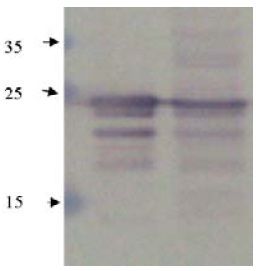
Recommended ApplicationsELISA (recommended work dilution= 1:800, 000(at least detecting 12.5 µg/ml), Western Blotting (recommended work dilution= 1:1000-5000(at least)), Immunodetection Analysis: Representative blot from a previous lot. Lane 1.recombinant protein CT-1. Lane 2. HepG2 cell lysate. The membrane blot wasprobed with anti-CT-1 primary antibody(0.25 µg/ml).Proteins were visualized using a goat anti-rabbitsecondary antibody conjugated to HRP andchemiluminescence detection system. Arrows indicatecellular CT-1 from human and mouse cells (24 kDa).
Reconstitution
A separate vial of dilution buffer is provided for reconstitution. The antibody is supplied lyophilized, originally containing PBS, without preservative stabilizers (e.g. sodium azide). The final amount is indicated on the shipping vial.
Shipping TypeAmbient temperature
Storage-20°C

Description

Description

Cardiotrophin-1 (CT-1) is a cardiac hypertrophic factor and belongs to the IL-6 cytokine family.The protein interacts with the glycoprotein 130 (gp130)/leukemia inhibitory factor receptor beta (LIFR)heterodimer. CT-1 deficiency causes increased motoneuron cell death in spinal cord and brainstemnuclei of mice. In addition, CT-1 enhances transcription factor NF kappa B DNA-binding activities andactivates phosphatidylinositol 3-kinase (PI-3 kinase) in cardiac myocytes. Studies have revealed CT-1 ishighly expressed in the heart, prostate, skeletal muscle, and ovary, and expressed at the lower levels inlung, kidney, pancreas, thymus, small intestine, and testis. CT-1 is highly secreted by myotubes, andpromotes the survival of cultured embryonic mouse and rat MNs. CT-1 is associated withpathophysiology of heart diseases, like hypertension, myocardial infarction, valvular heart disease, andcongestive heart failure.

Storage / Stability

The antibody is stable for at least 1 year from the date of receipt when stored at -20°C to -70°C. Reconstituted antibody can also be aliquotted and stored at 4°C for 1 month or at -20°C to -70°C in a manual defrost freezer for many months without detectable loss activity. Please avoid freeze-thaw cycles.

Specificity

Rabbit anti-Human Cardiotrophin-1 antibody detects specifically target derived from humanrecombinant protein as well as HepG2 cell lysates. Cross reactivity with mouse and rat CT-1 was nottested yet.

Related Products

Human Cardiotrophin-1 (CT-1) ELISA Kit For Serum, Plasma, Cell Culture Supernatant and Urine(Cat# ELH-CT1-001 ); Recombinant Human Cardiotrophin-1 (Cat# 230-00008)

References

  • Arce V, et. al. (1998) Synergistic effects of Schwann- and muscle-derived factors on motoneuronsurvival involve GDNF and cardiotrophin-1 (CT-1). J Neurosci 18:1440-1448.
  • Ronald W, et al. (2001). Cardiotrophin-1, a muscle-derived Cytokine, is required for the survival ofsubpopulations of developing motoneurons. J Neurosci. 21:1283-1291.
  • Arce V, et al. (1999) Cardiotrophin-1 requires LIFRbeta to promote survival of mouse motoneuronspurified by a novel technique. J Neurosci Res 55:119-126.
Expiration:
12 months from the date of shipment when stored properly.