3607 Parkway Ln Ste 200 Norcross, Georgia 30092
www.RayBiotech.com | info@raybiotech.com
770-729-2992 | +1-888-494-8555
ISO 13485:2016 cGMP

3607 Parkway Ln Ste 200 Norcross, Georgia 30092
www.RayBiotech.com | info@raybiotech.com
770-729-2992 | +1-888-494-8555
ISO 13485:2016 cGMP
Catalog #: RB-02-0015
Mouse anti-Microtubule-associated protein (Tau) Antibody
| Size | 20 µg, 100 µg, 200 µg, 500 µg |
| Estimated Lead Time | 1-2 business days |
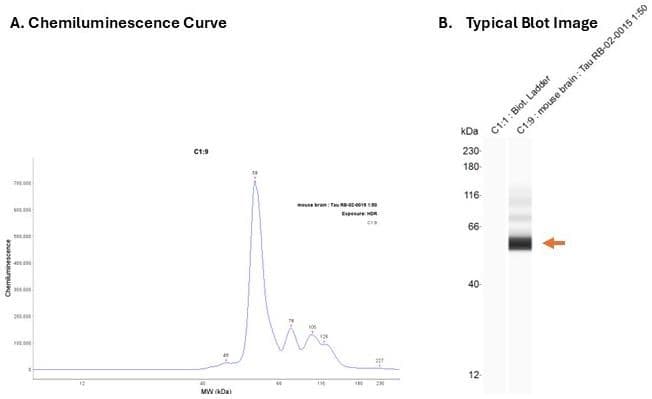
| Specificity | The antibody specifically detected the Tau protein derived from human brain tissue in both ELISA and WB. This antibody showed no cross-reactivity with other unrelated protein. |
| Accession Number | NP_058518 |
| Immunogen | Immunogen was recombinant protein derived from human Tau. This antibody was produced from a hybridoma resulting from the fusion of a mouse myeloma with B cells obtained from a mouse immunized with the immunogen. The IgG fraction of tissue culture supernatant was purified by Protein G/A affinity chromatography. |
| Recommended Applications | ELISA (recommended work dilution= 1:1, 000-4, 000), Western Blotting( recommended work dilution= 2-5 µg/ml), Note: Other applications are not tested yet. Optimal dilutions should be determined by each laboratory for each application. |
| Reconstitution | Supplied as lyophilized and purified antibody originally containing PBS, without Preservative Stabilizers, such as Sodium Azide. The final concentration is indicated on the shipping vial. The antibody is stable for at least years from the data of receipt when stored at -20°C to -70°C. Reconstituted antibody (recommended with H20 1 mg/ml) can also be aliquoted and stored frozen at -20°C to -70°C in a manual defrost freezer for months without detectable loss activity. Upon reconstitution, the antibody can be stored at 4°C for 1 month. Please avoid freeze-thaw cycles. |
| Research Area | Cytoskeletal Reorganization |
| Shipping Type | Ambient temperature |
| Storage | -20°C |
Your cart is empty.