Introduction
MAP kinase-interacting kinase 1 (Mnk1) and Mnk2, members of the Ser/Thr protein kinase family, bind tightly to the growth factor-regulated MAP kinases, Erk1 and Erk2. Erk and p38 phosphorylate MNK1 and Mnk2, which stimulates their in vitro kinase activity toward a substrate, eukaryotic initiation factor-4E (eIF-4E). Overexpression of Mnk2 results in increased phosphorylation of endogenous eIF-4E, showing that it can act as an eIF-4E kinase in vivo. Mnk2 may play a role in the response to environmental stress and cytokines. This ubiquitiously expressed protein appears to regulate transcription by phosphorylating eIF-4E, thus increasing the affinity of this protein for the 7-methylguanosine-containing mRNA cap. Expression of active mutants of MNK1 and MNK2 in 293 cells diminishes cap-dependent translation relative to cap-independent translation in a transient reporter assay. Human Mnk2 is homologous to murine Mnk2 (approximately 94% identical) and human Mnk1 (71% identical). In vitro phosphorylation studies show that Mnk2 is a significantly better substrate than Mnk1 for extracellular signal-regulated kinase 2 (Erk2), p38MAPKalpha, and p38MAPKbeta. Mnk2 has also been shown to interact with the C-terminal regions of eIF-4G1 and eIF-4G2.
Specificity
Predicted Reactivity
Mouse, Rat
Other Names
MKNK2; GPRK7; MNK2; MAP kinase-interacting serine/threonine-protein kinase 2; MAP kinase signal-integrating kinase 2
NCBI Accession #
NP_060042.2;NP_951009.1
Other Accession #
Q5U2N4; Q8CDB0
Format
Type
Purified Rabbit Polyclonal Antibody (Pab)
Calculated Molecular Weight (Da)
51875
Recommended Dilutions
WB: 1:1000
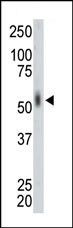 | The anti-MKNK2 Pab (Cat# 102-17103) is used in Western blot to detect MKNK2 in mouse lung tissue lysate. |
Antigen Source
HUMAN
Storage/Stability
2-8°C (short-term); -20°C (long-term)
Expiration:
12 months from the date of shipment when stored properly.