Introduction
Ubiquitin-like protein that can be covalently attached to proteins as a monomer or as a lysine-linked polymer. Covalent attachment via an isopeptide bond to its substrates requires prior activation by the E1 complex SAE1-SAE2 and linkage to the E2 enzyme UBE2I, and can be promoted by an E3 ligase such as PIAS1-4, RANBP2 or CBX4. This post-translational modification on lysine residues of proteins plays a crucial role in a number of cellular processes such as nuclear transport, DNA replication and repair, mitosis and signal transduction. Polymeric SUMO2 chains are also susceptible to polyubiquitination which functions as a signal for proteasomal degradation of modified proteins.
Specificity
Predicted Reactivity
Mouse, Bovine, Chicken, Humanamster, Pig, Monkey
Other Names
SUMO2;SMT3A; SMT3H2; Small ubiquitin-related modifier 2; Small ubiquitin-related modifier 2; HSMT3; Small ubiquitin-related modifier 2; SMT3 homolog 2; Small ubiquitin-related modifier 2; SUMO-3; Small ubiquitin-related modifier 2; Sentrin-2; Small ubiquitin-related modifier 2; Ubiquitin-like protein SMT3A
NCBI Accession #
NP_001005849.1;NP_008868.3
Other Accession #
P61959; P61958; P61957; Q2PFW2; Q6LDZ8; Q5ZJM9; P61955
Format
Type
Mouse Monoclonal Antibody (Mab)
Calculated Molecular Weight (Da)
10871
Recommended Dilutions
WB: 1:1000
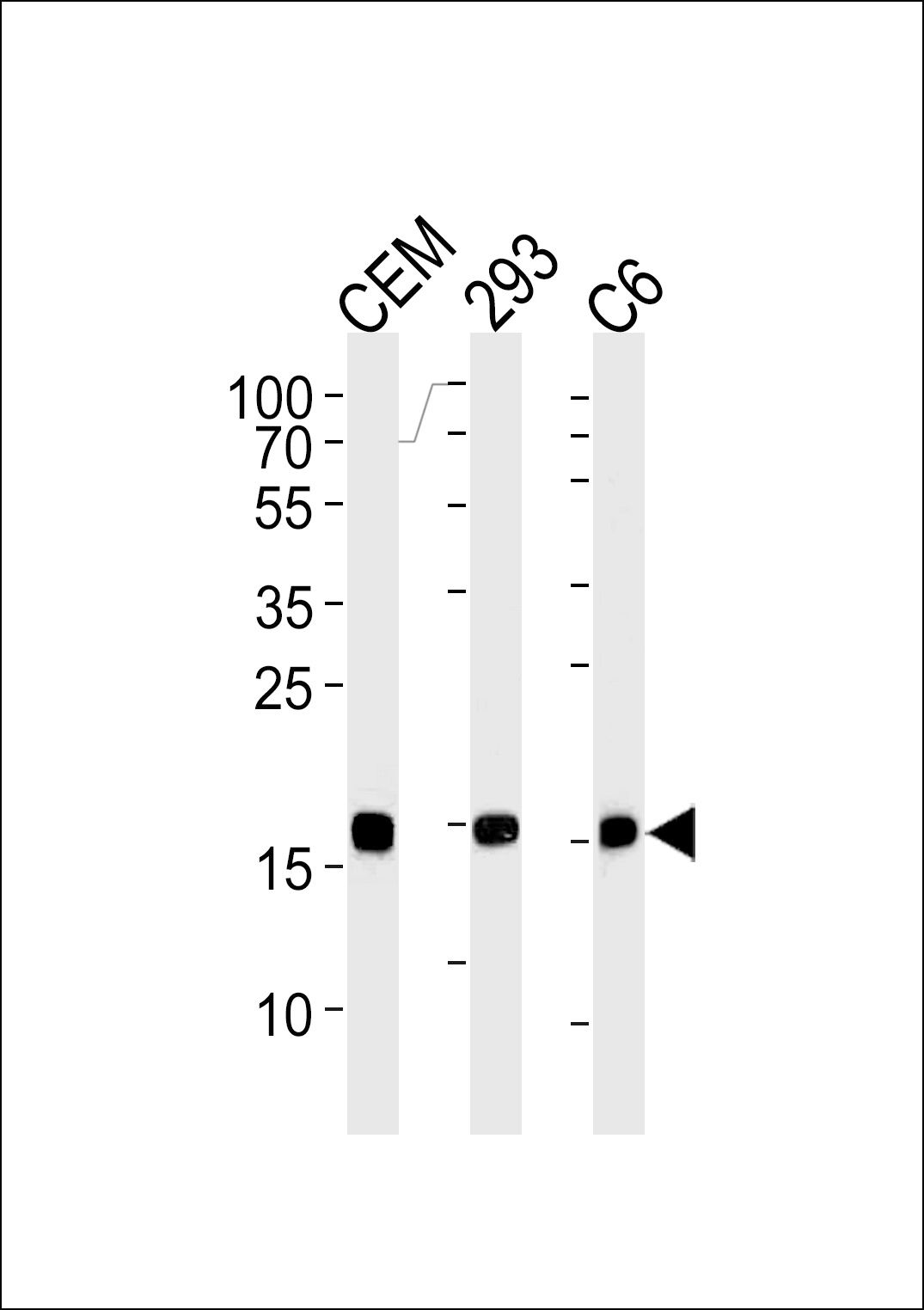 | SUMO2 Antibody (C-term)(Cat# 102-10452) western blot analysis in CEM,293,rat C6 cell line lysates (35ug/lane).This demonstrates the SUMO2 antibody detected the SUMO2 protein (arrow). |
Antigen Source
Human
Storage/Stability
2-8°C (short-term); -20°C (long-term)
Expiration:
12 months from the date of shipment when stored properly.