3607 Parkway Ln Ste 200 Norcross, Georgia 30092
www.RayBiotech.com | info@raybiotech.com
770-729-2992 | +1-888-494-8555
ISO 13485:2016 cGMP

3607 Parkway Ln Ste 200 Norcross, Georgia 30092
www.RayBiotech.com | info@raybiotech.com
770-729-2992 | +1-888-494-8555
ISO 13485:2016 cGMP
Catalog #: RB-08-0003
Rabbit Anti-Human Visfatin Antibody
| Size | 20 µg, 100 µg, 200 µg, 500 µg |
| Estimated Lead Time | 1-2 business days |
| Species | Human |
| Accession Number | NM_182790 |
| Immunogen | Immunogen was synthetic peptide derived from Human Visfatin. This antibody was produced from a rabbit immunized with the immunogen. The IgG fraction was purified from rabbitt serum by ammonium sulphate precipitation followed by Protein A/G affinity chromatography. |
| Immunogen Sequence | CVTKSYSFDEIRKNAQLNIELEAAHH |
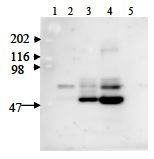
| Recommended Applications | ELISA (recommended work dilution= 1:10e6(at least detecting 10ng/ml)), Western Blotting (recommended work dilution= 1:1000-5000(at least)), Enzyme Immunoassay (EIA) (recommended work dilution= Sensitivity (100pg/ml)), (see image)Immunodetection Analysis: Representative blot from a previous lot. Lane 1.protein marker, Lane 2.Reference control, Lane 3-4.Positive control, Hela and MD231 whole cell lysate, Lane 5.Negative control. The membrane blot was probed with antiVisfatin primary antibody(1 µg/ml). Proteins were visualized using a goat anti-rabbit secondary antibody conjugated to HRP and chemiluminescence detection system. Arrows indicate cellular Visfatin from human and mouse cells (52 kDa). |
| Reconstitution | Supplied as lyophilized purified antibody. The antibody is stable for at least one year from the data of receipt when stored at -20°C to -70°C. Reconstituted antibody (recommended with H20 1 mg/ml) can also be aliquoted and stored frozen at -20°C to -70°C in a manual defrost freezer for months without detectable loss activity. Upon reconstitution, the antibody can be stored at 4°C for 1 month. If 1 ml of H20 is used, the antibody concentration will be 100 µg/ml. Please avoid freeze-thaw cycles. |
| Shipping Type | Ambient temperature |
| Storage | -20°C |
Your cart is empty.