Skip to navigationSkip to contentSkip to footer
  • Home
  • ELISA Kits

ELISA Kits

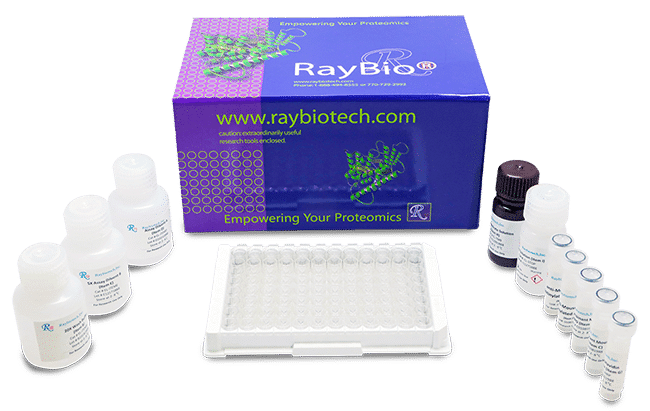
Enzyme-Linked Immunosorbent Assay (ELISA) kits are immunoassays designed to quantitatively detect specific proteins—such as cytokines, growth factors, hormones, and phospho-proteins—in commonly used sample types, including serum, plasma, cell culture supernatants, and lysates. RayBiotech provides over 7,000 ELISA kits targeting a broad range of analytes and species. Our ELISA kits utilize highly specific matched antibody pairs to ensure optimal sensitivity and reproducibility. These same antibody pairs are used in our cytokine arrays, enabling direct downstream validation of multiplex assay data. Get your ELISA kits straight from the source—manufactured in the USA and shipped the next business day.
Browse ELISA Kits
ELISA-kit

Why Choose RayBiotech ELISA Kits?

RayBiotech ELISA kits are trusted by researchers worldwide and cited in thousands of peer-reviewed publications, including high-impact journals such as Cell, Nature, and Science. Here’s why scientists choose RayBiotech:

  • Proven quality: Validated for reproducibility, with rigorous quality control and certified to ISO 13485:2016
  • Risk-free guarantee: Backed by our 90-day, 100% satisfaction guarantee
  • User-friendly: Easy-to-follow protocols, video tutorials on our YouTube channel, and PhD tech support—no call centers, no delays
  • Original manufacturer: Designed, developed, and manufactured in-house at our Peachtree Corners, Georgia facility
  • Fast shipping: In-stock with next business day shipping for most kits
  • Comprehensive Selection: Over 7,000 targets across 17+ species, available in multiple ELISA formats for different research needs
  • Affordable: Straight from the U.S. source (no tariff or reseller markups), with multi-plate kit sizes and bulk discounts available

Types of ELISAs
Sandwich ELISA

Get reliable and reproducible quantitative detection based on well-validated antibody pairs.

Competitive ELISA

Obtain accurate and precise analyte quantitation even in the absence of paired capture-detection antibodies.

Indirect ELISA

Achieve highly sensitive quantitation of antibodies in your sample with an indirect ELISA kit.

Phosphorylation ELISA

Detect and quantify protein phosphorylation, such as for signaling and regulatory control.

Cell-Based ELISA

Move quickly with the ability to conduct ELISAs directly on cells—no lysate preparation needed.

NexaTag® qIPCR ELISA

Combine the specificity of sandwich ELISA, the amplification power of PCR, and the versatility of bead technology.

Transcription Factor ELISA

Achieve easy, speedy, sensitive and high-throughput measurement of transcription factor activation.

Bridging ELISA

Quantify therapeutic antibodies and anti-drug antibodies with ELISAs that detect antigens with two or more identical binding sites.

Ligand Binding Assays

Conduct rapid, high-throughput screening and measurement of receptor-target or drug-target interactions.


ELISA-Services

Featured Service

ELISA Services

Maximize operational efficiency while receiving data you can depend on when you trust your ELISA service needs to the experienced scientists at RayBiotech.

See What ELISA Services Can Do For You

Rigorous Testing for Quality You Can Trust

At RayBiotech, we take our product quality very seriously. We apply a battery of rigorous product-specific quality control tests to ensure your experiments are set up to produce high-quality results.

Reproducibility and Precision

We evaluate intra-assay reproducibility on sandwich ELISA kits by running 2-3 positive control samples in duplicate on a single plate (maximum tolerance = 10% CV). We use 2-3 positive control samples and a full standard curve (maximum tolerance = 12% CV) in at least 2 independent experiments. Our lot-to-lot consistency is tested by comparing calculated concentrations of the 2-3 positive control samples with calibration curves of the current lot and previous lot (maximum tolerance = 20% CV).

Dilution Linearity and Recovery

We determine recovery by spiking various levels of target protein into biological samples. Our dilution linearity is tested by performing 2-fold and 4-fold dilutions. Recoveries typically range from 80-130% (maximum tolerance 70-150%). The biological samples tested include serum, EDTA plasma, citrate plasma, heparin plasma (normal healthy donors), and cell culture medium (DMEM or 1640). This testing series determines our recommended dilution ranges for serum and plasma. For lysate-specific sandwich ELISAs (catalog numbers ending in “-CL”), sample types include cell lysates and tissue homogenates of various origins.

Four Steps to Antigen Analysis

Each type of ELISA works a little differently, but they all follow the same basic process:

Step icon
Plate coating

First, antigens are directly or indirectly immobilized on the surface of micropates.

Step icon
Plate Blocking

Next, a blocking buffer containing an irrelevant protein is added to bind to the remaining surfaces.

Step icon
Antibody Incubation

Then, an antigen-specific antibody is added. It binds to the antigens during the incubation step.

Step icon
Detection

Finally, the signal generated by the direct or secondary tag on the antibody is detected and measured.


FAQ

Frequently Asked Questions

Still have questions?

Contact Us

An ELISA (enzyme-linked immunosorbent assay) is a technique used to measure the presence or concentration of antibodies, antigens, proteins, and glycoproteins in biological samples. They're used in various applications, including drug discovery, clinical diagnostics, and biopharmaceutical research.

Our ELISA kits typically contain:

  • Pre-Coated 96-well Strip Microplate
  • Wash Buffer
  • Stop Solution
  • Assay Diluent(s)
  • Lyophilized Standard
  • Biotinylated Detection Antibody
  • Streptavidin-Conjugated HRP
  • TMB One-Step Substrate

Custom ELISAs with an extended (typically 4 - 7 week) lead time contain antibody pairs and standards validated for multiplex array products, but not for the 96-well plate ELISA format. Therefore, they require a development and quality control phase, which we begin after we receive an order for the kit.

Kits that have already undergone development and passed RayBiotech's ELISA quality control tests have shorter (typically 1-2 day) lead times.

If the entire 96 well plate is used in 1 experiment, you can test 40 samples in duplicate. Each experiment requires an 8-point standard curve run in duplicate (16 wells total), which leaves 80 wells.

If you choose to use one plate in multiple experiments, we highly recommend including a new standard curve with every run. This reduces the number of potential samples by 8 (to account for the new standard curve points) but allows you to accurately interpret your results.

RayBio Sandwich ELISA kits do not contain biological reference samples. The recombinant standard may serve as a positive control or may be used for spike recovery studies.

The kit may have diminished activity after an extended period at room temperature, but it is most likely still usable, especially if left out for only a small amount of time. The most temperature-sensitive components in the kit are the standards, HRP-streptavidin, and detection antibody.

At RayBiotech we take our product quality very seriously. Every kit we produce is subjected to a battery of rigorous product-specific quality control tests and manufactured in compliance with GMP and ISO 13485 standards. Our Quality Statement can be viewed here.

Reproducibility and Precision

Our sandwich ELISA kits are evaluated for intra-assay reproducibility by running 2-3 positive control samples in duplicate on a single plate (maximum tolerance = 10% CV). Inter-assay reproducibility is evaluated by at least 2 independent experiments with 2-3 positive control samples and a full standard curve (maximum tolerance = 12% CV). Lot-to-lot consistency is tested by comparing calculated concentrations of 2-3 positive control samples with calibration curves of current lot and previous lot (maximum tolerance = 20% CV).

Dilution Linearity and Recovery

Recovery is determined by spiking various levels of target protein into biological samples. Dilution linearity is tested by performing 2-fold and 4-fold dilutions of biological samples. Recoveries typically range from 80-130% (maximum tolerance 70-150%). Tested biological sample types include serum, EDTA plasma, citrate plasma, heparin plasma (normal healthy donors) and cell culture medium (DMEM or 1640). Recommended dilution ranges for serum and plasma are determined from this testing series. For lysate-specific sandwich ELISAs (catalog numbers ending in "-CL"), sample types include cell lysates and tissue homogenates of various origins.

Our tips for sample preparation can be found here:

Tips on Sample Preparation

The ELISA kits with catalog numbers ending in "-CL" are optimized and validated for use with cell and tissue lysate samples. All other ELISA and EIA kits (catalog numbers without "-CL") have not been validated by RayBiotech with cell or tissue lysates, however RayBio kits can generally accommodate many different samples types. All RayBio Phosphorylation ELISA kits are validated with cell lysates.

When testing lysate samples, RayBiotech recommends diluting the samples at least 5-fold with the appropriate diluent buffer indicated in the protocol. This dilution minimizes interference caused by the detergents present in the lysis buffer. The recommended total protein concentration of your lysate is at least 1 mg/ml. The original lysate should then be diluted (5-fold or more is preferred) to a working concentration range of 50-500 µg/ml. Please note that these concentration ranges represent a starting point and may need to be further optimized by the researcher.

RayBiotech carries a lysis buffer (cat# EL-Lysis) which may be purchased separately. If the researcher prefers to prepare their own lysis buffer, they should review the guidelines stated at this link:

Tips on Sample Preparation

In brief, a lysis buffer used with RayBio ELISAs must meet the following specifications:

  • Has relatively low salt content (700 mM or less)
  • Does not contain sodium azide
  • Does not contain >0.1% SDS or other strongly denaturing surfactant
  • Does not contain >10 mM reducing agents (β-mercaptoethanol or dithiothreitol)

Buffers optimized for immunoprecipitation, such as RIPA buffer, generally meet these specifications.

  • Serum and plasma (based on normal healthy donors) - The recommended dilution ranges are indicated in the product manual, in Section V (Reagent Preparation).
  • Conditioned medium - The analyte levels depend entirely on the experimental conditions, thus optimal dilution factors must be determined empirically. However in general we recommend starting with no dilution or a 1:2 dilution of conditioned medium.
  • Lysates - We recommend 5-fold or greater to ensure minimal interference from lysis buffer detergents.
  • Other body fluids (saliva, CSF, urine, tears, BAL fluid, milk, etc.) - Optimal dilution ranges vary widely and should be determined by the researcher.

If you’re unsure where to start, the technical support team can assist you in locating a publication referencing a RayBio kit with a sample type similar to yours.

If your standard curve OD signals are low (highest standard < 0.7), please consider the following tips and best practices:

  • It is critical to briefly centrifuge the vials of Detection Antibody and Standard before opening, as the powders or liquid concentrates can collect inside the cap.
  • After reconstituting the standard with Assay Diluent, the liquid may be gently mixed by either pipetting up and down, or by alternately inverting and flicking the vial several times. The vial should then be centrifuged briefly to collect the liquid at the bottom of the tube. Vortexing is generally not recommended.
  • Weak signals may also be caused by inaccurate dilution of the Detection Antibody or HRP-Streptavidin. Double check the preparation of these reagents, as even a slight variation can produce a noticeable difference in signal.
  • Using shorter incubation times than what is recommended in the manual can cause lower signals. Conversely, incubating the standards overnight at 4˚C can boost the overall signals on the microplate.
  • After Stop Solution is added to each well, the OD should be read at 450 nm immediately. The color fades quickly, resulting in decreased OD’s.

When troubleshooting low OD, RayBiotech recommends preparing a fresh stock of standard (each kit comes with an extra vial of Item C) and retest using the tips above.

Low overall signals arise from a problem in the detection process – i.e., the Detection Antibody, HRP-Streptavidin or TMB One-Step Substrate). Please consider the following tips and best practices:

  • Detection Antibody – Be sure to centrifuge before reconstitution. Once reconstituted, this reagent must be used within a day or two. Each vial contains enough antibody for half of a plate (48 wells). Two tubes are provided in each kit.
  • HRP-Streptavidin – This reagent comes as a liquid concentrate. Before withdrawing any liquid from the tube, be sure to centrifuge the vial and pipet up and down to mix thoroughly, as precipitation may form in storage.
  • After dilution, the HRP-streptavidin solution must be used the same day. Discard the unused portion.
  • Never dilute the HRP-Streptavidin with Assay Diluent A. This diluent contains sodium azide, an inhibitor of HRP activity.
  • TMB One-Step Substrate - This component is stable for 6 months at 4˚C, but must be protected from light exposure.
  • Pre-coated Microplate – After opening the moisture barrier bag, any unused microplate strips must be stored at 4°C and used within 1 month. Return unused strips to the bag containing the desiccant pack, and reseal the bag along the entire edge.
  • Adhere to the kit storage guidelines (4˚C for 6 months or -20˚C for 1 year). Avoid multiple freeze-thaw cycles.

Common causes of high background include:

  • Too much HRP-Streptavidin can cause high background. To ensure the correct concentration of HRP-Streptavidin, briefly centrifuge the vial of (Item G) and pipet up and down to mix gently before using to dissolve any precipitate which may have formed during storage.
  • Too much Detection Antibody may also contribute to high background. Ensure the correct dilution of Biotinylated Antibody is used.
  • Long incubation times of sample and standard can cause high background. Please adhere to the recommended incubation times in the manual.
  • High background may be introduced if the plate is insufficiently washed or if the Wash Buffer is contaminated. Wash Buffer must be removed completely from the wells after each wash. An automated plate washer or multi-channel pipettor is recommended for best results. Never use a wash bottle to fill the wells with Wash Buffer.

Matrix effects are a common cause of non-linear dilution responses. This can occur when proteins or other components within the sample affect the immunoreactivity of the target molecule. These matrix components can also affect the ability of the antibody to recognize its target within the sample. Auto-antibodies, binding proteins, hemolysis, or certain disease states (e.g. highly lipemic samples) can contribute to this phenomenon. If matrix effects are suspected, centrifuge the sample and dilute further. When testing serum or plasma, a minimum 2-fold dilution is always recommended to avoid matrix effects.

Common causes of high well-to-well variability include:

  • Pipet performance – be sure pipets are calibrated and functioning properly
  • Bubbles in wells
  • Incomplete washing – ensure complete removal of wash buffer after each wash.
  • Using a wash bottle to wash the wells – a pipet or a plate washer is recommended.
  • Incomplete reagent mixing (particularly the Detection Antibody).

Still have questions?

Contact Us

Related Services

ELISA Services

Maximize operational efficiency while receiving data you can depend on when you trust your ELISA service needs to the experienced scientists at RayBiotech.

CRO Services

When you need a few extra hands to get an assay completed or support from experimental design to data analysis, our experienced team of scientists is ready to help.

Biostatistics and Bioinformatics

Whether you’re short on analytical resources or expertise, our experienced team can support your studies with a wide range of biostatistics and bioinformatics services.

Related Categories

Multiplex Assays

Discover faster and develop deeper insights with simultaneous profiling of antibodies, proteins, peptides, and more—brought to you by the most experienced company in the business.

Antibodies

Choose from a wide range of pre-conjugated and unlabeled antibodies raised in a wide variety of species—all manufactured to the exacting standards you’ve come to expect from RayBiotech.

Proteins and Peptides

Whether you need a purified recombinant protein or peptide, overexpressed protein in cell extract or supernatant, a natively produced protein, or related reagents like protease inhibitors, you’ll find a quality product for confident discovery.

Products
  • Multiplex Assays
  • ELISA Kits
  • Proteins and Peptides
  • Antibodies
  • Flow Cytometry
  • Assay Kits
  • Molecular Biology

Sign up to get promotions on your favorite research tools and research updates.

Sign up to Newsletter (opens in new tab)
Services
  • Multiplex Assay Services
  • ELISA Services
  • Antibody Services
  • Custom Protein Services
  • CRO Services
  • Flow Cytometry Services
  • Simoa – Single Molecule Array Services
Resources
  • Manual Protocols
  • Resource Library
  • Learning Center
  • Array Analysis Tools
  • Publications / Citations
  • Publications by RayBiotech Scientists
About Us
  • About RayBiotech
  • Careers
  • Quality Systems
  • Business Partnerships
  • News & Events
  • Reducing Our Emissions
Contact Us
  • Contacts
  • Distributors
  • Certified Service Providers
ISO 13485:2016cGMP
ISO 17025:2017CLIA
©2007-2026 RayBiotech, Inc. All rights reserved.Life Science Web Design By Supreme
  • Privacy Policy
  • Terms & Conditions
  • ISO Certification
  • Risk Free Guarantee
  • Promotions

What customers are saying

Quote icon
“Amazing kit [Mouse Copeptin EIA, Cat# EIAM-COP]. Easy to handle, convenient based on incubation time. Highly sensitive, gives me appropriate results. Awesome product!!!“

Purnima

University of Tennessee Health Science Center

Quote icon
“The Phospho-PTEN (S380)/ total PTEN ELISA [CAT# PEL-PTEN-S380-T] works very well and gives repetitive and accurate results with lysates from cancer cell lines.”

Marina

Australis Pharmaceuticals

Need Help?770-729-2992
MY ACCOUNT

Your cart is empty.

RayBiotech
RayBiotech
  • Products
    • Multiplex Assays
    • ELISA Kits
    • Proteins
    • Antibodies
    • Flow Cytometry
    • Assay Kits
    • Molecular Biology
    • Other Products
    • Human Cytokine Array C5
    • Human IL-6 ELISA
    • Human Inflammation Array Q3
    • Mouse Cytokine Array C3
    • Recombinant SARS-CoV-2 Spike Protein, S1 Subunit
    • Human Phosphorylation Pathway Profiling Array C55
    • Antibody Arrays
    • Proteome Profiling Arrays
    • Cytometric Bead Arrays
    • Epitope Mapping Peptide Arrays
    • Protein Arrays
    • PTM Multiplex Assays
    • NexaTag® Ultrasensitive Multiplex ELISA
    • Sandwich ELISA
    • Competitive ELISA
    • PTM ELISA
    • NexaTag® Ultrasensitive qIPCR ELISA
    • Indirect ELISA
    • Bridging ELISA
    • Cell-Based ELISA
    • Recombinant Proteins
    • GMP Proteins
    • Native Proteins
    • Peptides
    • Primary Antibodies
    • Secondary Antibodies
    • Flow Cytometry Antibodies
    • Isotype Controls
    • Antibody Pairs
    • Flow Cytometry Antibodies
    • Flow Cytometry Reagents
    • Flow Cytometry Assays
    • Cytometric Bead Arrays
    • Fluorescent Beads
    • Quantum Dots
    • Metabolism Assays
    • Ligand Binding Assays
    • Drug Antibody (DA) & ADA Assays
    • Transcription Factor Activity Assays
    • PCR Assays
    • Nucleic Acid Assays
    • Epigenetics
    • Mitochondrial Assays
    • Reagents
    • Cell Culture
    • Biospecimen Samples
    • Sample Collection & Preparation
    • Lysates
    • Mass Spectometry Reagents
    • Magnetic Beads
    • Lab Equipment and Supplies
    • Biological Buffers

    Featured Products

    Human Cytokine Array C5Human IL-6 ELISAHuman Inflammation Array Q3Mouse Cytokine Array C3Recombinant SARS-CoV-2 Spike Protein, S1 SubunitHuman Phosphorylation Pathway Profiling Array C55
  • Services
    • Multiplex Assay Services
    • ELISA Services
    • Protein Services
    • Antibody Services
    • CRO Services
    • Flow Cytometry Services
    • SIMOA – Single Molecule Array
    • Other Services
    • Quantitative Proteomics Services
    • Discovery Proteomics Services
    • Custom Arrays
    • Array Scanning and Analysis
    • Custom Protein Production
    • GMP Protein Production
    • IHC Controls
    • Stable Cell Line Development
    • Molecular Biology Services
    • Antibody Production
    • Recombinant Antibody Expression
    • Bulk Antibody Production
    • Antibody Conjugation Services
    • Cell Biology Services
    • Epitope Mapping Services
    • Biomarker Discovery
    • Cell Biology Services
    • Antibody Drug Development & Characterization
    • Pharmacokinetic and Pharmacodynamic Analysis
    • Assay Development Services
    • Molecular Biology Services
    • Multiomics Services
    • Diagnostic Assay Development
    • GMP Protein Production
    • Biostatistics and Bioinformatics
    • Bulk Antibody Production
    • QC Testing Services
    • Auto-Western Blot Service
    • COVID-19 Pseudovirus Service
    • Biospecimen Samples & Sample Services
    • RNA & DNA Methylation Detection Services
  • Research Areas
    • Cell Signaling Pathways
    • Areas of Interest
    • Akt Signaling Pathway
    • AMPK Signaling pathway
    • ErbB Signaling Pathway
    • Hedgehog Signaling Pathway
    • HIF1-alpha Signaling Pathway
    • IGFR1 Signaling Pathway
    • JAK-STAT Signaling Pathway
    • MAPK Signaling Pathway
    • mTOR Signaling Pathway
    • NF-kappaB Signaling Pathway
    • Notch Signaling Pathway
    • p53 Signaling Pathway
    • PKC Pathway
    • TGF-beta Signaling Pathway
    • Wnt/beta-Catenin Pathway
    • Antibody Drug Development
    • Autoimmunity & Inflammation
    • Cancer
    • Cardiovascular Disease
    • Infectious Disease & Vaccines
    • Neuroscience
    • Obesity
    • Post Translational Modifications
    • RNA & DNA Modifications
  • Resources
    • Assay Picker Tool
    • Sample Shipment Instructions
    • Sample Preparation Tips
    • Publications / Citations
    • Promotions
    • Resource Library
    • Learning Center
    • Manual Protocols
    • Array Analysis Tools
  • Contact Us
    • Distributors & Service Providers
  • About Us
    • Quality Systems
    • Business Partnerships
    • Careers
    • News & Events