The RayBio® Mouse Mitochondrial DNA Damage Quantification Kit is a Taqman® probe-based qPCR assay for the specific quantitative measurement of Mouse mtDNA damage.
Loading...
Loading...
Loading...
Loading...
| Size | 100 tests, 500 tests |
| Estimated Lead Time | 1-2 business days |
| Species | Mouse |
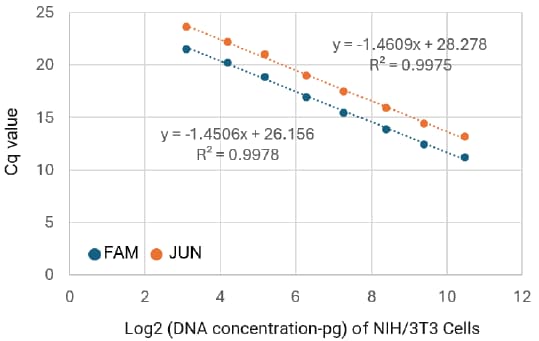
| Sensitivity | 0.1 ng |
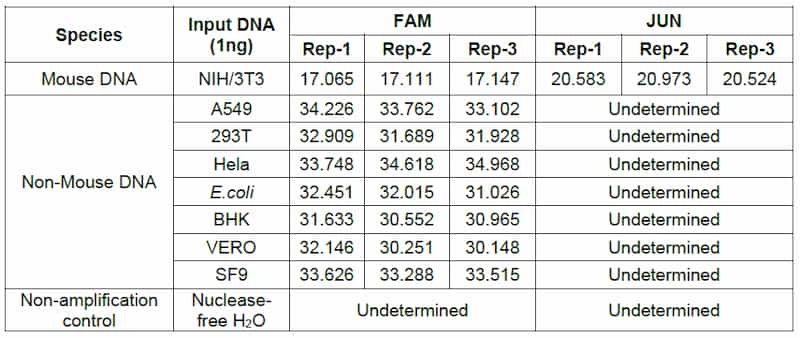
| Specificity | The non-mouse and non-amplification control samples have higher Cq values than mouse DNA or are undetermined, which means there is high specificity for mtDNA amplification. |
| Quantitative/Semi-Quantitative | Quantitative |
| Research Area | Neuroscience, Cardiovascular Disease, Cancer, DNA Damage |
| Shipping Type | Dry ice (additional shipping fee) |
| Storage | -20°C |
The maintenance of mitochondrial genomic integrity is a prerequisite for proper mitochondrial function. Excessive oxidative stress can cause mitochondrial DNA (mtDNA) to be damaged by loss of its supercoiled structure. Accumulation of lesions in mtDNA is believed to be one of the causes of energy crisis in aging tissues as well as with numerous diseases including neurodegenerative disorders, cardiovascular diseases and cancer. Damage to mtDNA is also a meaningful biomarker for evaluating genotoxicity of drugs and environmental toxins. Mice have become the most ubiquitous model organism used to study human disease. Mice are strikingly similar to humans at the genomic level and the pathophysiology of disease in mice is similar to that of humans. Moreover, mice are a cost-effective and efficient tool to enhance research and drug testing.
The RayBio® Mouse Mitochondrial DNA Damage Quantification Kit (MTM-DQ) is a Taqman™ probe-based qPCR assay for the specific quantitative measurement of mouse mitochondrial DNA damage. This kit targets the long mtDNA region (D-Loop gene), which is the most susceptible to damage. Gene-specific Taqman™ probe qPCR is highly sensitive because of the use of “long” PCR methodology that permits the quantitative amplification of fragments of genomic DNA. As a result, very low levels of lesions can be detected, permitting the study of mtDNA damage using genomic DNA from cultured cells, tissue, saliva, urine, blood, etc.
| Component | Size / Description |
|---|---|
| 2X Probe qPCR Master Mix | 1 mL / 1 tube |
| Primer and Probe Mix | 1 mL / 1 tube |
| Damaged DNA | 20 µL/1 tube |
| Non-Damaged DNA | 20 µL / 1 tube |
| Nuclease-free H2O | 1 mL / 1 tube |
Contact our technical support team for questions about compatibility: techsupport@raybiotech.com
The non-mouse and non-amplification control samples have higher Cq values than mouse DNA or are undetermined, which means there is high specificity for mtDNA amplification.
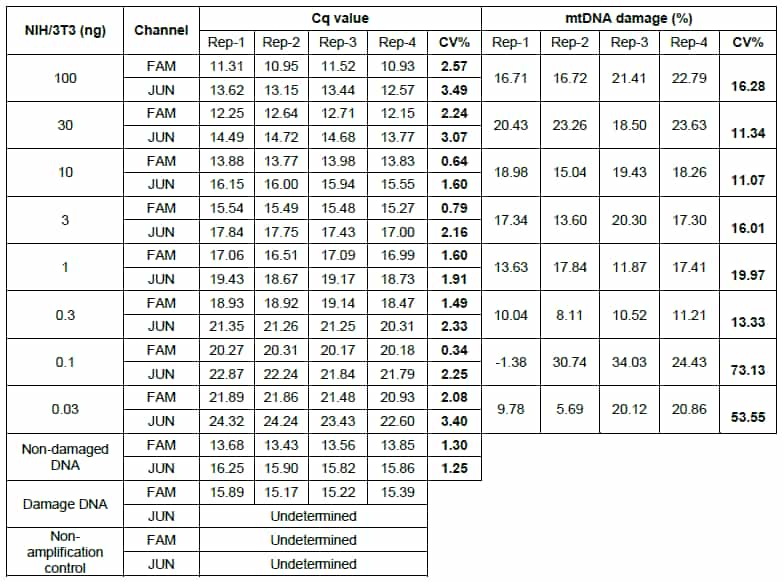
CV < 5% for Cq value and CV < 15% for mtDNA damage when the input DNA ≥ 0.3 ngreaction.
The kit can be stored at -20°C for a period of 12 months prior to opening. After opening, the reagents are valid for at least 6 months if stored at -20°C. Avoid repeated freeze-thaw cycles.
Your cart is empty.
Mouse Mitochondrial DNA Damage Quantification Kit
We used this kit, along with a mitochondrial DNA copy number kit, to evaluate mitochondrial health in mouse models. The kit is user-friendly, and the calculation process is straightforward. It requires a qPCR machine equipped with FAM and JUN detection channels.
Review by Kai's lab, from Columbia University Hammer Health Science Center, on Apr 5, 2025
Mouse Mitochondrial DNA Damage Quantification Kit


