Mpox Biology
Another public health threat has the world on alert — a global outbreak of the Mpox virus (formerly known as Monkeypox). As of June 28, 2022, the US has identified 306 cases in 27 states and the District of Columbia, while more than 4,700 cases have been identified in over 40 countries worldwide (CBS). In this blog, we will give a quick overview of the basic biology of the Mpox virus.
Introduction
Mpox is a zoonotic (virus transmitted to humans from animals) disease which results in smallpox-like symptoms in humans. The Mpox virus belongs to the genus Orthopoxvirus, and family Poxviridae. The Orthopoxvirus genus includes 11 distinct but very closely related species (Table 1). Smallpox, a severe disease that resulted in high mortality rates, was caused by a thr Variola virus member of this family of viruses. Through a successful containment strategy and an effective vaccine and vaccination program, the World Health Organization declared global eradication of smallpox in the mid-1980s. The vaccine that helped eradicate smallpox was the closely related vaccinia virus — a prototype of the family that is commonly studied in laboratories as a model poxvirus. Because routine vaccination for smallpox ended years ago, there is growing concern that Mpox maybe the next viral pandemic.
| Species | Animals Infected |
|---|---|
| Variola | Human |
| Vaccinia | Human, cow, pig, buffalo, rabbit, etc. |
| Cowpox | Rodent, cow, human, cat, etc. |
| Mpox | Squirrel, monkey, ape, human |
| Ectromelia | Mouse, mole |
| Camelpox | Camel |
| Taterapox | Gerbil |
| Volepox | Vole |
| Raccoonpox | Raccoon |
| Skunkpox | Skunk |
| Uasin Gishu | Horse |
Table 1. Eleven viruses included in the Orthopoxvirus genus and animals infected (adopted from https://www.ncbi.nlm.nih.gov/books/NBK230917/)
History
Mpox virus was originally discovered in 1958 when an outbreak of a pox-like disease occurred in a monkey colony kept for research in a Danish laboratory. The first human case was recorded in 1970 in a 9-month-old baby boy in the Democratic Republic of the Congo (where it is endemic). Since then, it spread to other regions of west and central Africa. Epidemiological studies revealed two different clades of Mpox virus — the west African clade with a milder form of disease, and lower rates of fatality and human-to-human transmission — and the central African clade with a more severe form with increased transmissibility. The first Mpox outbreak outside of Africa was identified in the US in 2003 and was linked to contact with infected pet prairie dogs. However, with the recent outbreak, as of May 2022, multiple cases of Mpox were identified in several other non-endemic countries.
The virus
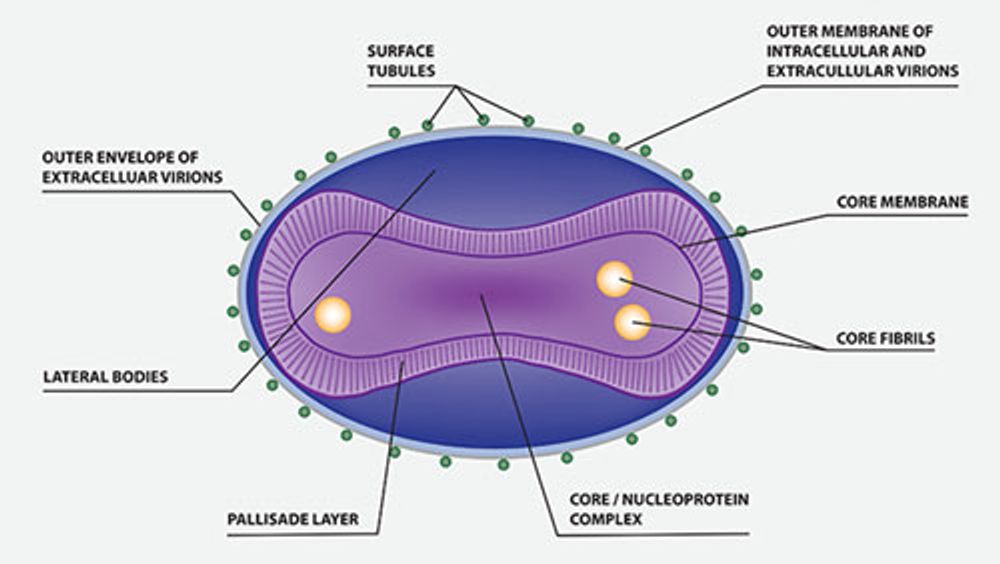
Poxviruses are enveloped, brick-shaped, large (240-300 nm) DNA viruses enclosed by a corrugated lipoprotein outer membrane that replicate entirely in the cytoplasm. They have a linear double-stranded genome (130-230 kbps) that encode for approximately 200 proteins — some structural and some non-structural. The common proteins are responsible for cross-reactive immunity which allows for vaccination against disease from another poxvirus of the same genus.
Poxvirus DNA synthesis is detected 2 hours post infection. The first step in the infection cycle is attachment of the virus to the surface of the invading host. For poxviruses, the synthesis of messenger RNA takes place before uncoating and is mediated by RNA polymerase and other enzymes packed within the virion. Early messenger RNA is translated into proteins that uncoat the virus and allow for replication and transcription of a second class of intermediate genes which allow for transcription of a late class of genes that is ultimately translated into structural and enzyme components of the virion. The final phase of the growth cycle is when the virus exits the cell by lysis or more commonly by exocytosis.
Clinical features of infection
The clinical features of Mpox closely resemble those of smallpox. After infection, there is a 10–14-day incubation period which is followed by a prodrome period of 2 days. During this prodrome period (before the appearance of a rash), patients may experience fever, chills, malaise, headache, back ache, sore throat, shortness of breath and swollen lymph nodes. A possible distinguishing characteristic of Mpox from smallpox maybe the enlarged lymph nodes in the submandibular, cervical, and inguinal regions. This feature is seen in about 90% of Mpox cases. After this prodrome period, a maculopapular rash develops with lesions ranging from 0.2 – 1 cm. This is also the time when the patient is most infectious. The lesions appear in the face, trunk and extremities and can progress through multiple stages from papules, vesicles, pustules, and a final crusting phase where there is scabbing and peeling of skin.
Laboratory diagnosis of Mpox
The optimal sample type for diagnosing Mpox are skin lesions as they are known to have the highest quantity of virus. Swabs should include lesion surface and/or exudate, roofs from more than one lesion or lesion crusts. Polymerase chain reaction (PCR) is the preferred laboratory test given its accuracy and sensitivity; however, it cannot be used for diagnoses after the infection has cleared. Therefore, other techniques that rely on the host's immune response to the virus are being used, including enzyme-linked immunosorbent assays (ELISA) that use subtle antigenic differences between viruses for detection.
Spread, prevention and outlook
It is possible to contract Mpox if scratched, bitten by, or preparing/eating meat from an infected animal. The virus can spread human-to-human through direct contact with an infectious rash, scabs, or body fluids, touching items that previously contacted infectious individuals or respiratory secretions during intimate contact. Pregnant mothers can pass on the infection through the placenta to the fetus.
The CDC does not recommend widespread vaccination for Mpox at this time, however frequent hand washing and avoiding close contact with infectious individuals and animals is recommended.
While there are no specific treatments for Mpox, due to its genetic similarity to smallpox, certain antiviral therapies (tecovirimat) recommended for smallpox maybe given to individuals who experience severe illness.
Browse RayBiotech's catalogue of Mpox Research products including real-time PCR detection kits, recombinant proteins, ELISA assays and protein arrays.
References
- Centers for Disease Control and Prevention. (2022, June 30). Monkeypox. Centers for Disease Control and Prevention. Retrieved July 12, 2022, from https://www.cdc.gov/poxvirus/monkeypox/index.html
- CBS Interactive. (2022, July 7). Monkeypox Cases Rise 77% in a week, who reports: "concerned by the scale and spread of the virus". CBS News. Retrieved July 12, 2022, from https://www.cbsnews.com/news/monkeypox-cases-rise-77-percent-week-world-health-organization/
- World Health Organization. (n.d.). Monkeypox. World Health Organization. Retrieved July 12, 2022, from https://www.who.int/news-room/fact-sheets/detail/monkeypox Bunge, E. M., Hoet, B., Chen, L., Lienert, F., Weidenthaler, H., Baer, L. R., & Steffen, R. (2022). The changing epidemiology of human Monkeypox—a potential threat? A systematic review. PLOS Neglected Tropical Diseases, 16(2). https://doi.org/10.1371/journal.pntd.0010141
- Institute of Medicine (US) Committee on the Assessment of Future Scientific Needs for Live Variola Virus. Assessment of Future Scientific Needs for Live Variola Virus. Washington (DC): National Academies Press (US); 1999. 2, Variola Virus and Other Orthopoxviruses. Available from: https://www.ncbi.nlm.nih.gov/books/NBK230917/
- McFadden, G. (2005). Poxvirus tropism. Nature Reviews Microbiology, 3(3), 201–213. https://doi.org/10.1038/nrmicro1099
- Moss B. Poxvirus DNA replication. Cold Spring Harb Perspect Biol. 2013 Sep 1;5(9):a010199. Doi: 10.1101/cshperspect.a010199. PMID: 23838441; PMCID: PMC3753712.