Simultaneously measure phosphorylated protein and pan protein in one experiment (for normalization purpose)
Screen numerous different cell lysates without performing a Western Blot analysis
Minimal hands-on time, convenient, and non-radioactive material
Typical Data
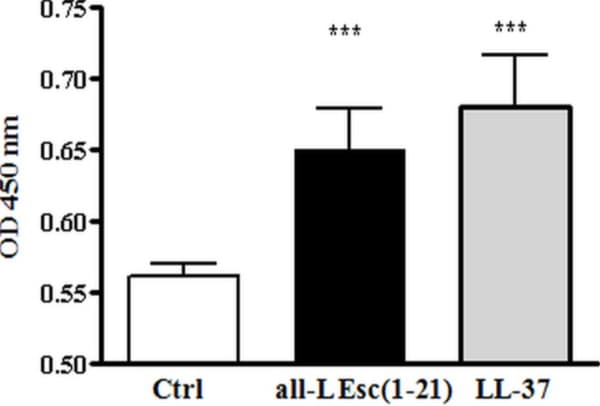
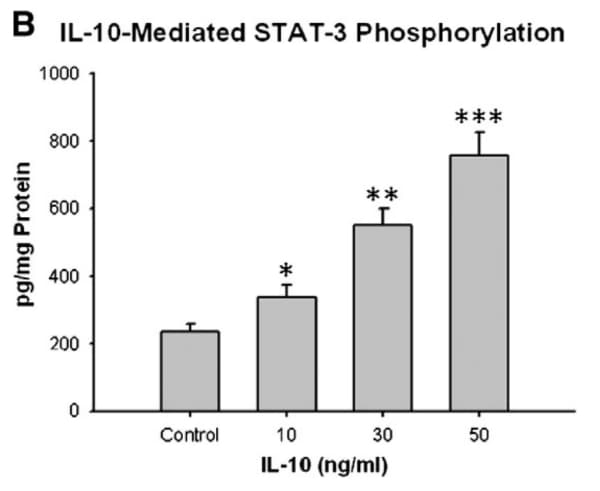
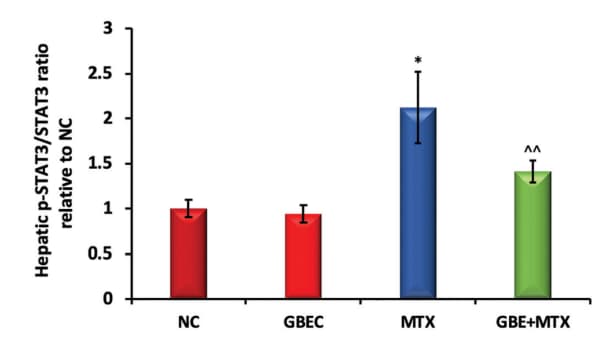
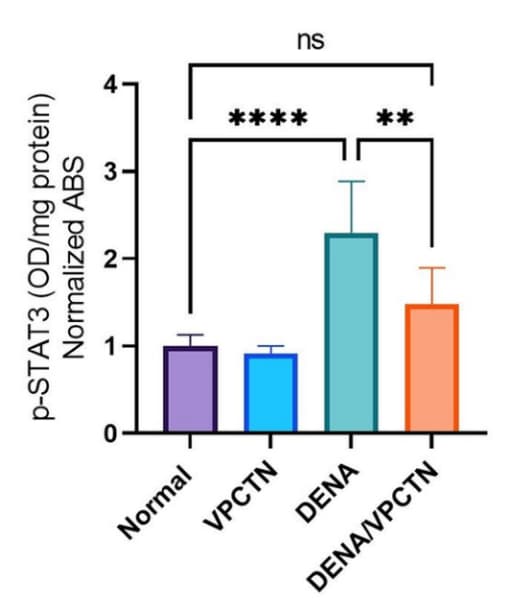
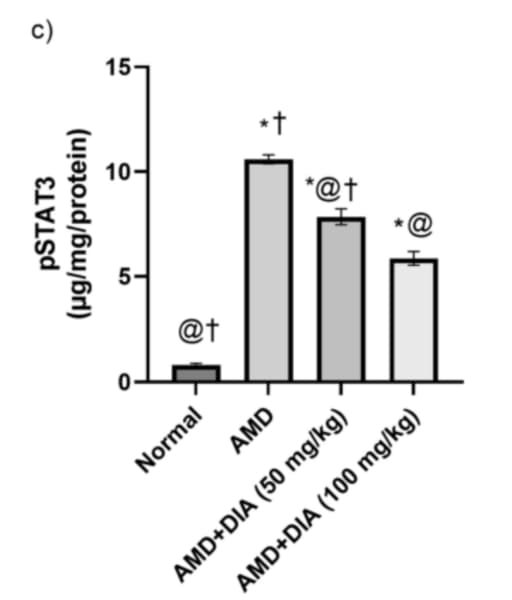
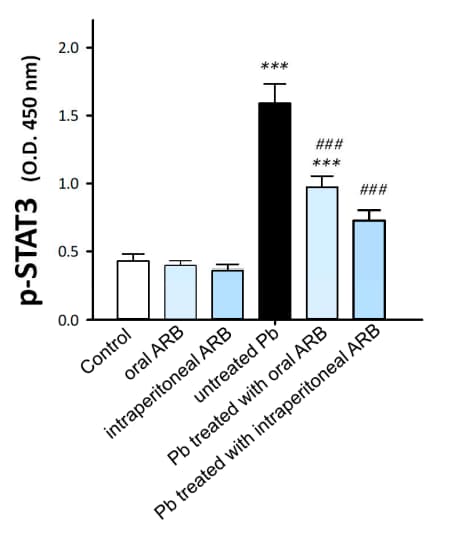
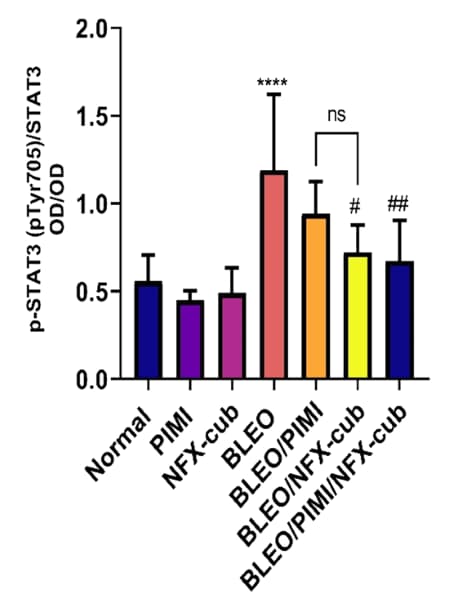
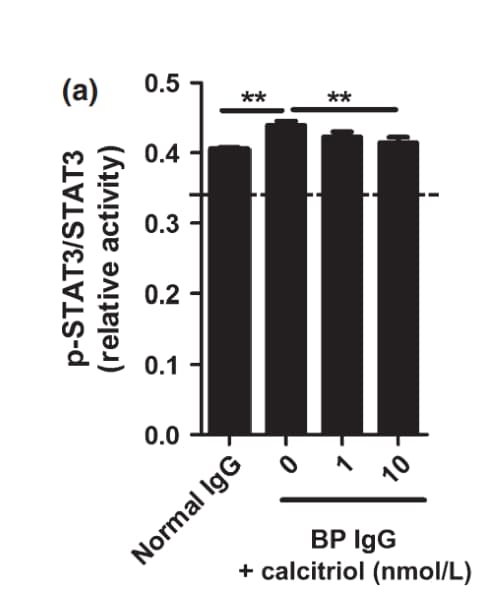
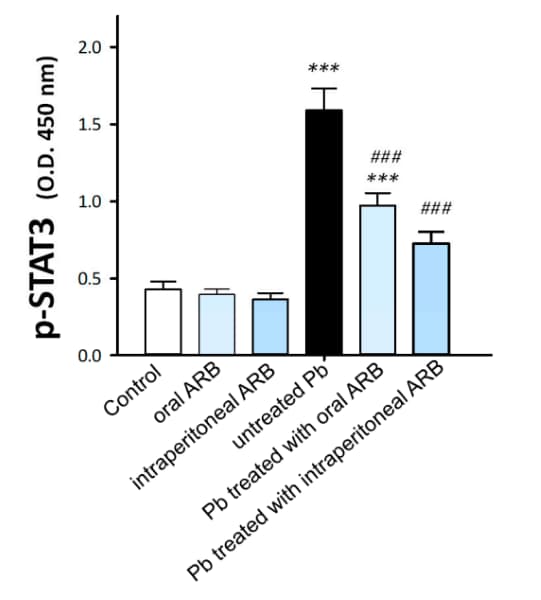
RayBio® Phospho-STAT3 (Y705) ELISA Kit was used to assess STAT3 activation in HaCaT keratinocytes following peptide treatment. Figure adapted from Di Grazia et al., PLOS ONE, 2015. RayBiotech's PEL-STAT3-Y705 ELISA revealed a concentration-dependent increase in STAT-3 phosphorylation in primary rat neuronal cultures upon IL-10 treatment. Figure adapted from Sharma et al., Brain Research, 2011. RayBiotech's PEL-STAT3-Y705 ELISA revealed that Ginkgo biloba extract inhibited STAT3 phosphorylation in methotrexate-induced hepatotoxicity. Figure adapted from Sherif & Al-Shaalan, Drug and Chemical Toxicology, 2020. RayBiotech's PEL-STAT3-Y705 ELISA revealed that vinpocetine suppressed STAT3 phosphorylation in a diethylnitrosamine-induced hepatocellular carcinoma model. Figure adapted from Mohammed et al., PLOS ONE, 2024. RayBiotech's PEL-STAT3-Y705 ELISA kit assessed STAT3 phosphorylation, showing diacerein reduced p-STAT3 in amiodarone-induced pulmonary fibrosis. Figure adapted from Farouk et al., Naunyn-Schmiedeberg€™s Archives of Pharmacology, 2024. RayBiotech's PEL-STAT3-Y705 ELISA kit assessed STAT3 phosphorylation, showing that arbutin reduced p-STAT3 in lead acetate-induced testicular injury. Figure adapted from Arab et al., Pharmaceuticals, 2024. RayBiotech's PEL-STAT3-Y705 ELISA kit was used to assess STAT3 phosphorylation in a study on nifuroxazide and pimitespib treatment for bleomycin-induced pulmonary fibrosis. Figure adapted from El-Kashef et al., Biomedicine & Pharmacotherapy, 2022. RayBiotech's Phospho-STAT3-Y705 and Total-STAT3 ELISA kits were used to assess STAT3 phosphorylation and total STAT3 levels in keratinocytes treated with bullous pemphigoid autoantibodies. Figure adapted from Tukaj et al., Journal of the European Academy of Dermatology and Venereology, 2015. RayBiotech's Phospho-STAT3-Y705 ELISA kit was used to assess STAT3 phosphorylation in a study investigating the protective effects of arbutin against lead acetate-induced testicular injury. Figure adapted from Arab et al., Pharmaceuticals, 2024.
Kit Components
Pre-Coated 96-well Strip Microplate
Wash Buffer
Anti-Phospho Antibody
Anti-Pan Antibody (*not included in phospho-only version)
HRP-Conjugated Secondary Antibody
Assay Diluent
TMB One-Step Substrate
Stop Solution
Lysis Buffer
Positive Control Sample
Additional Materials Required
Distilled or deionized water
100 mL and 1liter graduated cylinders
Tubes to prepare sample dilutions
Protease and Phosphatase inhibitors
Precision pipettes to deliver 2 µL to 1 mL volumes
Adjustable 1-25 mL pipettes for reagent preparation
Benchtop rocker or shaker
Microplate reader capable of measuring absorbance at 450 nm
Assay Procedure Summary
Prepare all reagents and samples as instructed in the manual.
Add 100 µL of sample or positive control to each well.
Incubate 2.5 hours at RT or O/N at 4 °C.
Add 100 µL of prepared primary antibody to each well.
Incubate 1 hour at RT.
Add 100 µL of prepared 1X HRP-Streptavidin to each well.
Incubate 1 hour at RT.
Add 100 µL of TMB One-Step Substrate Reagent to each well.
Incubate 30 min at RT.
Add 50 µL of Stop Solution to each well.
Read at 450 nm immediately.
Storage/Stability
Upon receipt, the kit should be stored at -20°C. Please use within 6 months from the date of shipment. After initial use, Wash Buffer Concentrate, Assay Diluent, TMB One-Step Substrate Reagent, HRP-Streptavidin, Stop Solution and Cell Lysate Buffer should be stored at 4°C to avoid repeated freeze-thaw cycles. Return unused wells to the pouch containing desiccant pack, reseal along entire edge and store at -20°C. Reconstituted Positive Control should be stored at -70°C.