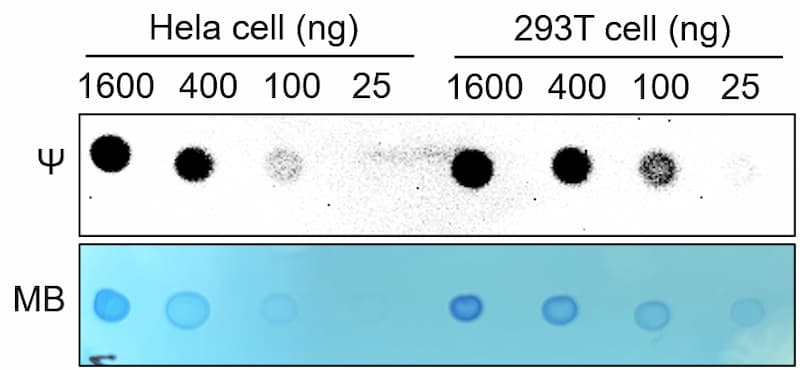
Pseudouridine, abbreviated by the Greek letter psi-Ψ, is an isomer of the nucleoside uridine in which the uracil is attached via a carbon–carbon instead of a nitrogen–carbon glycosidic bond. Ψ was first discovered in 1957. To date, Ψ has been recognized as an abundant post-transcriptionally modified nucleoside in the RNA of various organisms. Ψ is an irreversible modification found in transfer RNA (tRNA), ribosomal RNA (rRNA), and small nuclear RNA (snRNA). The biosynthesis of Ψ is carried out via post-transcriptional modification of the substrate RNAs by a class of enzymes called pseudouridine synthases (PUS). Several studies have confirmed an important role for Ψ modification in different aspects of gene regulation which affect gene translation, splicing, telomere maintenance and gene expression regulation.
The RayBio® Pseudouridine Dot Blot Assay Kit is a reliable, simple, and rapid method of quantifying the global Ψ RNA modification levels in RNA samples collected from humans, rats, mice and other species.
The entire kit may be stored at -20°C to -80°C for up to 12 months from the date of shipment. For extended storage, it is recommended to store it at -80°C. Avoid repeated freeze-thaw cycles.