Skip to navigationSkip to contentSkip to footer
Need Help?770-729-2992
MY ACCOUNT
CART
RayBiotech
RayBiotech
  • Products
    • Multiplex Assays
    • ELISA Kits
    • Proteins
    • Antibodies
    • Flow Cytometry
    • Assay Kits
    • Molecular Biology
    • Other Products
    • Human Cytokine Array C5
    • Human IL-6 ELISA
    • Human Inflammation Array Q3
    • Mouse Cytokine Array C3
    • Recombinant SARS-CoV-2 Spike Protein, S1 Subunit
    • Human Phosphorylation Pathway Profiling Array C55
    • Antibody Arrays
    • Proteome Profiling Arrays
    • Cytometric Bead Arrays
    • Epitope Mapping Peptide Arrays
    • Protein Arrays
    • PTM Multiplex Assays
    • NexaTag® Ultrasensitive Multiplex ELISA
    • Sandwich ELISA
    • Competitive ELISA
    • PTM ELISA
    • NexaTag® Ultrasensitive qIPCR ELISA
    • Indirect ELISA
    • Bridging ELISA
    • Cell-Based ELISA
    • Recombinant Proteins
    • GMP Proteins
    • Native Proteins
    • Peptides
    • Primary Antibodies
    • Secondary Antibodies
    • Flow Cytometry Antibodies
    • Isotype Controls
    • Antibody Pairs
    • Flow Cytometry Antibodies
    • Flow Cytometry Reagents
    • Flow Cytometry Assays
    • Cytometric Bead Arrays
    • Fluorescent Beads
    • Quantum Dots
    • Metabolism Assays
    • Ligand Binding Assays
    • Drug Antibody (DA) & ADA Assays
    • Transcription Factor Activity Assays
    • PCR Assays
    • Nucleic Acid Assays
    • Epigenetics
    • Mitochondrial Assays
    • Reagents
    • Cell Culture
    • Biospecimen Samples
    • Sample Collection & Preparation
    • Lysates
    • Mass Spectometry Reagents
    • Magnetic Beads
    • Lab Equipment and Supplies
    • Biological Buffers

    Featured Products

    Human Cytokine Array C5Human IL-6 ELISAHuman Inflammation Array Q3Mouse Cytokine Array C3Recombinant SARS-CoV-2 Spike Protein, S1 SubunitHuman Phosphorylation Pathway Profiling Array C55
  • Services
    • Multiplex Assay Services
    • ELISA Services
    • Protein Services
    • Antibody Services
    • CRO Services
    • Flow Cytometry Services
    • SIMOA – Single Molecule Array
    • Other Services
    • Quantitative Proteomics Services
    • Discovery Proteomics Services
    • Custom Arrays
    • Array Scanning and Analysis
    • Custom Protein Production
    • GMP Protein Production
    • IHC Controls
    • Stable Cell Line Development
    • Molecular Biology Services
    • Antibody Production
    • Recombinant Antibody Expression
    • Bulk Antibody Production
    • Antibody Conjugation Services
    • Cell Biology Services
    • Epitope Mapping Services
    • Biomarker Discovery
    • Cell Biology Services
    • Antibody Drug Development & Characterization
    • Pharmacokinetic and Pharmacodynamic Analysis
    • Assay Development Services
    • Molecular Biology Services
    • Multiomics Services
    • Diagnostic Assay Development
    • GMP Protein Production
    • Biostatistics and Bioinformatics
    • Bulk Antibody Production
    • QC Testing Services
    • Auto-Western Blot Service
    • COVID-19 Pseudovirus Service
    • Biospecimen Samples & Sample Services
    • RNA & DNA Methylation Detection Services
  • Research Areas
    • Cell Signaling Pathways
    • Areas of Interest
    • Akt Signaling Pathway
    • AMPK Signaling pathway
    • ErbB Signaling Pathway
    • Hedgehog Signaling Pathway
    • HIF1-alpha Signaling Pathway
    • IGFR1 Signaling Pathway
    • JAK-STAT Signaling Pathway
    • MAPK Signaling Pathway
    • mTOR Signaling Pathway
    • NF-kappaB Signaling Pathway
    • Notch Signaling Pathway
    • p53 Signaling Pathway
    • PKC Pathway
    • TGF-beta Signaling Pathway
    • Wnt/beta-Catenin Pathway
    • Antibody Drug Development
    • Autoimmunity & Inflammation
    • Cancer
    • Cardiovascular Disease
    • Infectious Disease & Vaccines
    • Neuroscience
    • Obesity
    • Post Translational Modifications
    • RNA & DNA Modifications
  • Resources
    • Assay Picker Tool
    • Sample Shipment Instructions
    • Sample Preparation Tips
    • Publications / Citations
    • Promotions
    • Resource Library
    • Learning Center
    • Manual Protocols
    • Array Analysis Tools
  • Contact Us
    • Distributors & Service Providers
  • About Us
    • Quality Systems
    • Business Partnerships
    • Careers
    • News & Events
Products
  • Multiplex Assays
  • ELISA Kits
  • Proteins and Peptides
  • Antibodies
  • Flow Cytometry
  • Assay Kits
  • Molecular Biology

Sign up to get promotions on your favorite research tools and research updates.

Sign up to Newsletter (opens in new tab)
Services
  • Multiplex Assay Services
  • ELISA Services
  • Antibody Services
  • Custom Protein Services
  • CRO Services
  • Flow Cytometry Services
  • Simoa – Single Molecule Array Services
Resources
  • Manual Protocols
  • Resource Library
  • Learning Center
  • Array Analysis Tools
  • Publications / Citations
  • Publications by RayBiotech Scientists
About Us
  • About RayBiotech
  • Careers
  • Quality Systems
  • Business Partnerships
  • News & Events
  • Reducing Our Emissions
Contact Us
  • Contacts
  • Distributors
  • Certified Service Providers
ISO 13485:2016cGMP
ISO 17025:2017CLIA
©2007-2026 RayBiotech, Inc. All rights reserved.Life Science Web Design By Supreme
  • Privacy Policy
  • Terms & Conditions
  • ISO Certification
  • Risk Free Guarantee
  • Promotions

Your cart is empty.

  • Home
  • Learning Center
  • COVID-19
  • SARS-CoV-2 Variants: An Emerging Landscape of Therapeutic Targets
May 17, 2021|COVID-19|Valerie Jones, PhD

SARS-CoV-2 Variants: An Emerging Landscape of Therapeutic Targets

In recent months, viral strains of SARS-CoV-2 have been detected that are unusual in that they have accumulated mutations in the virus' genetic code that diverges from the wild-type (WT) Wuhan SARS-CoV-2 strain. These viral strains with accumulated genome mutations are known as SARS-CoV-2 variants. As SARS-CoV-2 variants continue to emerge, the U.S. Centers for Disease Control (CDC) has systematically classified them in three categories: variants of high consequence, variants of concern, and variants of interest.1 Currently, no SARS-CoV-2 variant occupies the highest category, variants of high consequence. This category would include variants that fail to be detected by diagnostics, have a significant reduction in susceptibility to vaccines, and present with more severe clinical disease. The lowest category, variants of interest, contains variants with suspected implications on viral transmission and immune escape and often lead to demographic cluster infections. Current variants of interest include Zeta, Eta, Theta, Iota, Kappa, and Lambda. Four independent SARS-CoV-2 variants of concern (VOCs) have emerged in the UK (Alpha; B.1.1.7), South Africa (Beta; B.1.351), Brazil (Gamma; P.1), and, most recently, India (Delta; B.1.617.2) with mutations of high interest (Figure 1) (Table 1). These variants show reduced susceptibility to vaccines, decreased neutralization by antibodies, an increase in transmissibility, along with an increase in disease severity (Table 1). The rapid dominance of these variants within their originating countries, and in other countries to which they have spread, has raised concerns about their potential impact on current COVID-19 countermeasures, including vaccines, therapeutics, and diagnostics, thus highlighting the need for continual sequence surveillance.
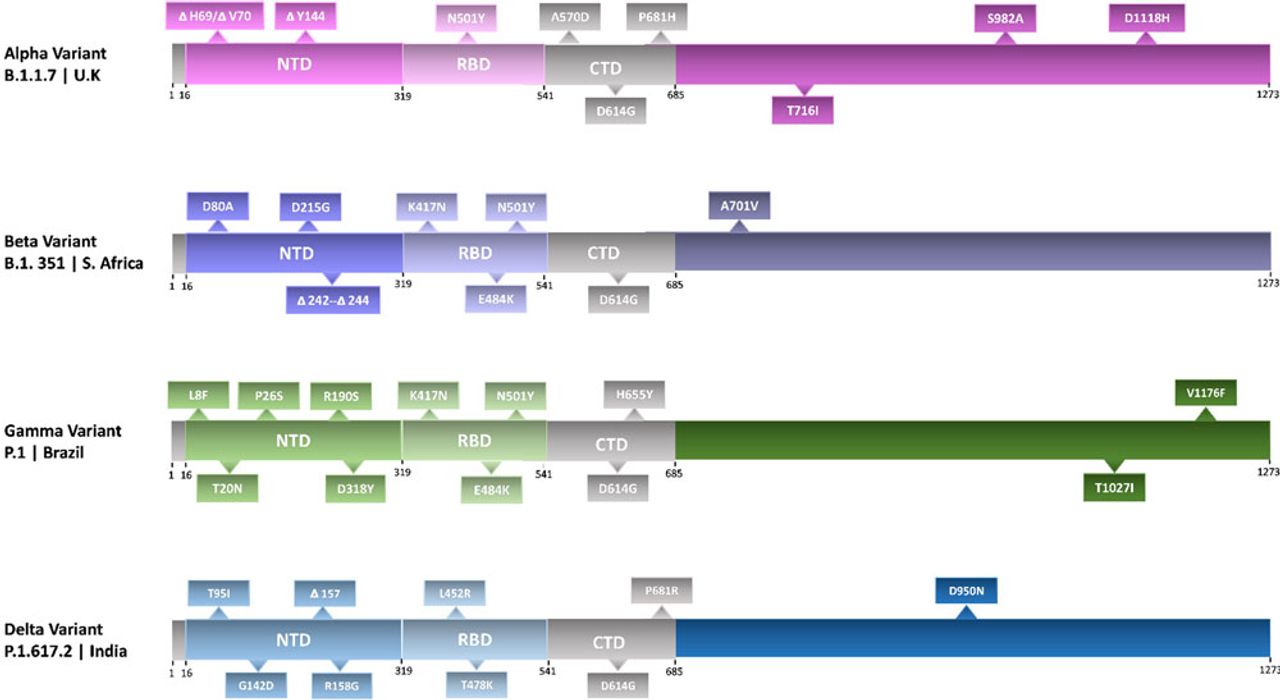
SARS-CoV-2 Variants and their respective mutations

Figure 1. SARS-CoV-2 Variants and their respective mutations. NTD= n-terminal domain, RBD= receptor binding domain, CTD=c-terminal domain.

Table 1
Variants of Concern
B.1.1.7 (Alpha) B.1.351 (Beta) P.1 (Gamma) B.1.617.2 (Delta)
First Originated UK, December 2020 South Africa, December 2020 Brazil, January 2021 India, December 2020
Current Spread 110 Countries
50 US States
68 Countries
35 US States
37 Countries
29 US States
98 Countries
50 US States
Disease severity Increased Increased Increased Significantly increased
Vaccine Effectiveness Pfizer/BioNTech
AstraZeneca/Vaxzevria
Novavax/Coravax
Pfizer/BioNTech
Novavax/Coravax
Moderna
Pfizer/BioNTech
Sinovac/Coronavac
Pfizer/BioNTech
AstraZeneca/Vaxzevria
Neutralizing Ab efficacy Minimal effects Reduced; vaccine efficacy significantly reduced Reduced Reduced; vaccine efficacy significantly reduced
Critical Spike Mutations
in RBD N501Y, E484K* K417N, E484K, N501Y K417T, E484K, N501Y E484Q, L452R
in NTD Δ69-70, Δ1444 Δ242-244 L18F, T20N Δ157
Other D614G, P681H D614G D614G D614G

Leave a Reply

*= detected in some sequences but not all.
RBD = receptor binding domain; NTD = N-terminal domain.

First generation vaccines and therapeutics have been developed based on the wild-type (WT) Wuhan Spike protein sequence which was released in January 2020 (Genbank accession: QHD43416).2 The Spike protein's receptor binding domain (RBD) binds cellular ACE2 to gain cell entry. The independent emergence of common Spike mutations in alpha, beta, gamma, and delta variants indicates that these changes may confer an evolutionary advantage. Understanding the effects of these mutations on vaccine efficacy, disease progression, therapeutic response, and transmissibility is important for mitigating or limiting their effects.

Spike RBD variants are likely to affect measurable parameters because these residues have been targeted for vaccine and therapeutic purposes. Only a small subset of antibodies produced against a virus are neutralizing. Neutralizing antibodies bind the virus in a manner that prevents infection, for example, by blocking interaction with its receptor. The Spike RBD-ACE2 binding interface is a short 25 amino acid sequence essential for infection,3 which makes it a target for natural and vaccine-induced neutralizing antibodies. Furthermore, its small size means that sequence alterations can lead to immune escape. All four VOCs have mutations in this region and the rapid worldwide spread of alpha, beta, and delta variants is cause for concern. In the US, the percentage of new COVID-19 cases caused by the delta variant as of August 14th, 2021 is 86%. Furthermore, the variant causing the first cases of COVID-19 in the U.S. in January 2020 is no longer detected in the population.4

The transmissibility of the beta variant appears unaltered, but this strain is more difficult to neutralize than its parental strains. Of 20 monoclonal antibodies (mAbs) tested against B.1.351, 14 have compromised or abrogated effects and, in South Africa, vaccine efficacy against this strain is as low as 57%.3

First identified in the beta variant, the E484K "escape" mutation has since been observed in gamma and in some alpha variant strains. E484K helps the virus evade the immune response, and increased antibodies are required to prevent infection with multiple variants exhibiting the E484K mutation.5 Structurally, the E484K mutation results in a Spike protein side chain charge change, preventing salt bridge formation and allowing the virus to bind more tightly to human cells as well as escape from the effects of some mAbs.3

The N501Y RBD mutation, initially identified in the alpha variant and subsequently appearing in both beta and gamma variants, increases the RBD binding affinity for ACE2. This leads to enhanced viral transmission but not increased virulence.6,7. This mutation has shown a decrease in the efficacy of some mAb treatments such as bamlanivimab and estesevimab, supporting the therapeutic use of antibody cocktails.3

D614G is common to all four VOCs and is surrounded by conserved amino acids. D614G has led to increased transmissibility and is correlated with high viral loads. G614 stabilizes the Spike protein and prevents premature dissociation from the target cell, resulting in increased infectivity.8,9 Receptor binding is not altered by this mutation and vaccines generated against D614 (WT) are effective against G614.9

Mutations at K417 increase the affinity of the RBD to ACE2, increase chances of immune escape, and reduce mAb response and convalescent plasma-mediated neutralization.10 K417N and K417T RBD mutations have been identified in beta and gamma variants, respectively. In combination with their common E484K and N501Y mutations, K417 alterations induce a relatively large conformational change that may increase the potential for immune escape.11

E484Q and L452R are a unique combination of mutations found in the fast-emerging delta variant. These mutations together result in increased ACE2 binding and rate of S1-S2 cleavage leading to better transmissibility and a higher viral load in infected individuals.12 Furthermore, the RBD carrying this pair of mutations exhibits decreased binding to selected mAbs and may affect their neutralization potential.12 More experimental validation is warranted of the effectiveness of commonly elicited neutralizing mAbs against delta variant strains carrying these mutations.

The emergence and spread of multiple SARS-CoV-2 variants have led to a rush to understand the consequences of the changes. This has also caused a shift toward the development of second and third generation vaccines less reliant on disrupting the RBD-ACE2 interaction. Recent reports indicate that an individual having previously had a COVID-19 infection can increase the efficacy of current vaccines against novel variants, including the beta "escape" variant.5 However, as additional SARS-CoV-2 variants emerge, it will become increasingly important to evaluate their effects alone and in combination with existing variants. In support of these efforts, RayBiotech has developed a suite of tools to assist detection of neutralizing activity against Spike mutants - including from antibodies, sera, small molecules, or other agents with the potential to block the Spike RBD-ACE2 interaction. Efficient surveillance of protective immune responses against new variants will require laboratories to adopt high throughput screening methods. RayBiotech's range of Spike variant binding assays enable the researcher to screen dozens of Spike RBD-ACE2 inhibitors in parallel. The Spike variant-specific kits include the alpha variant (including the N501Y and D614G mutations), the beta variant (including K417N, E484K, and N501Y mutations), and the gamma variant (including K417T, E484K, and N501Y mutations). Binding assays for the individual Spike protein mutations N501Y (useful for alpha, beta, and gamma variant strains), E484K alone (in beta and gamma variants but only in some alpha variant strains), and D614G (useful for alpha, beta, gamma, and delta variant strains), are also available. More information about Spike-targeted binding assays can be found here.

References
  1. https://www.cdc.gov/coronavirus/2019-ncov/cases-updates/variant-surveillance/variant-info.html (accessed 05/05/2021).
  2. Wu, F., Zhao, S., Yu, B. et al. A new coronavirus associated with human respiratory disease in China. Nature 579, 265–269 (2020). https://doi.org/10.1038/s41586-020-2008-3
  3. Zhou et al., 2021, Cell 189, 2348–2361. April 29, 2021 https://doi.org/10.1016/j.cell.2021.02.037
  4. https://covid.cdc.gov/covid-data-tracker/#variant-proportions (accessed 05/05/2021).
  5. BMJ 2021; 372: n359)
  6. Starr, T. N. et al. Cell 182, 1295–1310 (2020).
  7. Liu Y, Liu J, Plante KS, Plante JA, Xie X, Zhang X, Ku Z, An Z, Scharton D, Schindewolf C, Menachery VD, Shi PY, Weaver SC. The N501Y spike substitution enhances SARS-CoV-2 transmission. bioRxiv [Preprint]. 2021 Mar 9:2021.03.08.434499. doi: 10.1101/2021.03.08.434499. PMID: 33758836; PMCID: PMC7986995.
  8. Wang, R., Chen, J., Gao, K. et al. Analysis of SARS-CoV-2 mutations in the United States suggests presence of four substrains and novel variants. Commun Biol 4, 228 (2021). https://doi.org/10.1038/s42003-021-01754-6
  9. Zhang et al. Science 30 Apr 2021: Vol. 372, pp. 525-530 DOI: 10.1126/science.abf2303).
  10. Kai Wuet al. bioRxiv 2021.01.25.427948; doi: https://doi.org/10.1101/2021.01.25.427948
  11. Gard Nelson et al. bioRxiv 2021.01.13.426558; doi: https://doi.org/10.1101/2021.01.13.426558
  12. Rees-Spear, Chloe et al. Cell reports, Vol 134, issue 12, 23 March 2021.
  13. Cherian et al. bioRxiv 2021.04.22.440932; doi: https://doi.org/10.1101/2021.04.22.440932